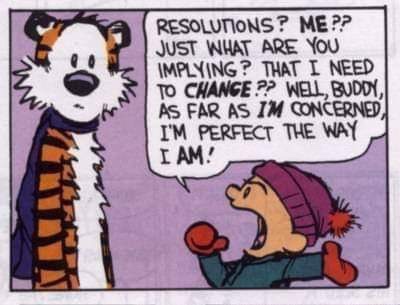
This is a panel from Calvin and Hobbes, a daily American comic strip created by cartoonist Bill Watterson.
Entering this new year from a place of gratitude and abundance will help me lay a foundation of self-compassion.
New Year Resolutions have not been part of my past make up.
This, my 61th trip around the sun, however, I am making a few based on the emotions that I plan to nurture, feed and grow in 2022 to broaden my life as it grows shorter.
I will filter all that I see through a lens of love.
I will choose kindness.
I will honor and cherish my body.
I will live with absolute aliveness by my own standards.
I will choose courage.
I will cultivate relationships.
I will have more art, music and nature in my life.
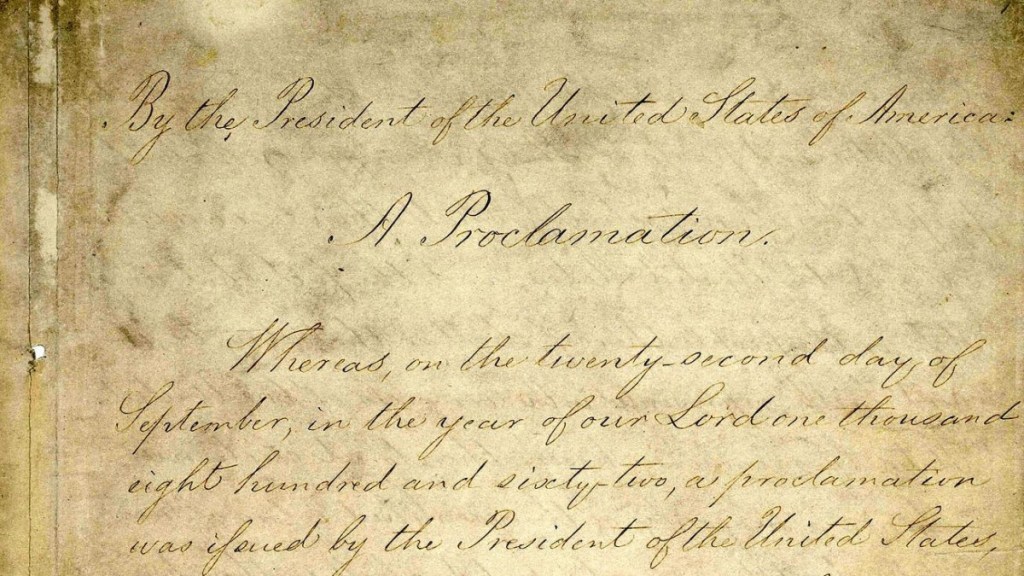
January 1, 1863 ~ President Abraham Lincoln signed the Emancipation Proclamation abolishing slavery except in non-rebelling or occupied states like Delaware, Maryland, Kentucky and parts of Louisiana.
The proclamation declared “that all persons held as slaves” within the rebellious states “are, and henceforward shall be free.”
Although Lincoln personally opposed human enslavement, he did not believe the federal government had the power to end it in the states. His goal, and that of the fledgling Republican Party he led, was only to keep it from spreading into the western territories where, they thought, enslaved labor would enable wealthy enslavers to dominate the region quickly, limiting opportunities for poorer white men.
So that I could start the new year off fresh, I am being intentional about ending 2021 with reflections.
Tayja’s high school graduation and start of college, my taking a digital storytelling class, my committing to regular blogging and my hard earned improved health are my highlights of 2021.
The loss of family members to Covid-19 and not being able to travel to be with dying family members because of Covid were the low points.
“2021” was a pivotal year for me. I turned 60. I took control of my health.
I had neglected myself for most of my life. The 2020 Covid shutdown changed my mindset and I ramped up my commitment in 2021. Health is wealth. I am banking on me.
I am eating cleaner, getting over 10000 steps most days, going bodyweight exercises or lifting a couple times a week, seeing a large assortment of specialists, and getting at least 7 hours of sleep every night.
I took control of my work life. For the last five years, I have work at an independent 6th to 12th school. My official job title is facilities worker. My assigned duties are to keep an eye on the cleaning contractors who are on campus from 6ish to 10ish, make sure the people who rent the gyms, theater and classrooms at night have what they need, and lock up the campus at night. I also have been the primary sub for both upper and lower school, coach middle school basketball and mentor young coaches.
In 2021 I assigned MYSELF to teach one of the older teachers all things digital so that he can have the digital literacy to teach his 7th graders digital storytelling. I stepped up to mentor two new, young middle school teachers. I volunteered to be the advisor for the schools new non-binary affinity group. I picked up an average of 4 substitute teaching days per week. I join the faculty book club, “critical conversation”, queer affinity and non-white affinity groups AND attend the meetings. I attend anything that the black and brown students do after school. I eat lunch with any kid of color that I see eating alone.
I took control of my spare time. I started taking classes in things that interesting me including, Audio Storytelling, Digital Storytelling, figure drawing, August Wilson’s American Century Cycle and black history. I listened to 3 or 4 audio books every week. I added several nonfiction books to the mix. I read several trashy novels just for the pleasure of turning and smelling the pages.
I think that reading most of the plays in August Wilson’s American Century Cycle, a collection of ten plays that chronicle a collective century of the Black American experience -with each of the ten plays set in a different decade spanning the 20th century – had the most impact on me out off all the books this year. I will re-read the collection and finish the couple I did not make time for in 2022.
My container garden produced six different colors of potatoes, eight types of cucumbers, seven varieties of tomatoes, garlic, shallots, red, white and yellow onions, kale, collards, strawberries, blueberries, basil, spearmint, thyme, sunflowers, artichoke, broccoli, cauliflower, pees, beans, marigolds and wildflowers.
I took control of my spending with an eye towards retirement and maxed out my IRA and increased my 401 contributions.
My joy in 2021 came from watching my youngest child crush their senior year of high school and soar into their first year of college, visiting with my two oldest kids and finding creative ways to do “date nights” with my wife in a time of Covid.
I am grateful that my wife could work from home and my worksite took Covid seriously with enforced masking, social distancing and mandatory vaccinations and weekly testing. We survived 2020 and 2021 without bringing the virus into our home. I count that as my biggest win and my biggest worry of a difficult year.
My biggest regret in 2021 is that I lost my habit of drawing every day. I will revive the habit in 2022.
I will make the rest of my life, the best of my life. I must be the star of my own life. To do that — to live my vision, to be the star of my own life — I need to learn how to hold fast. I say no to things that don’t feel right. I say yes to my vision for my own life. I play the long game. I bet on myself. I do my work and play my game. I trust what I know to be true, even when everyone else is telling me something different. I allow myself to deviate from the usual success formulas and the way things have always been done.Life doesn’t just happen to you, but you create it.
I cannot control every aspect of the world around me; I can take control of how I interpret and deal with things in my environment. I believe in my resilience. Patience is everything.
The person who understands principles can choose their own methods. – Warwick Schiller
Most children are amazing critical thinkers until we silence them. ~ bell hooks
Romjul is the period in the Norwegian calendar that starts on the third day of Christmas, Dec. 27, and ends on New Year’s Eve, Dec. 31. Comes from the Old Norse adjective rúmheilagr ( ‘not holy by law’)
Work on turning your “me time” into a habit, and make it part of your regular routine.
Make it a priority to laugh when you can and add some fun to each day.
“I may be personable, but I assure you I am a lion.” ~
August Wilson
You may not think that a few minutes will make a difference but carving out a little time here and there can add up to a greater feeling of personal freedom to do what you’d really enjoy.
Tell the people in your life how much you appreciate them. From people in your family to sales clerks and postal employees you encounter in your day, everyone likes to know that they’re appreciated.
There is a story around every corner.
Practice writing your stories in a humorous way. You may first write them as you’ve experienced them, but then shift into creative writing mode and mine your experiences for the humor and rewrite in the style of your favorite author.
“As crimes pile up, they become invisible.”–Bertolt Brecht
“fragmentation,” Israel’s policy of keeping “Palestinian communities isolated from one another and surrounded by fences, walls, checkpoints, closed gates, roadblocks, trenches, and bypass roads.”
Intermittent explosive disorder, or IED, an impulse-control disorder characterized by sudden explosions of unwarranted anger.
Omnipotence means all-powerful or has no limitations. Omniscience means all-knowing.
A child is ready to go away for college if the answer to all of the next four questions is yes:
Does my child have the strength of character to say no?
Are they independent—really?
Would I feel comfortable leaving my house and letting them fend for themselves?
Could I go weeks without talking to them, secure in the knowledge they are fine?
The approach to anti-racist transformation must change in order for true progress to occur, and that starts with providing Chief Diversity Officers with the power and resources to do their jobs effectively.
The rule is you have to dance in the morning before you leave the house because it changes the way you walk out in the world. — Sandra Bullock
Pearson’s Law ~ “When performance is measured, performance improves. When performance is measured and reported back, the rate of improvement accelerates.”
“Involve me and I learn.”
Excessive optimism is a common cognitive bias.
immune escapability – ability of viruses to evade immunity that one has from inoculation or prior infection
intrinsic transmissivity – how infectious the virus is and how quickly it spreads
Go where the trip takes you and see what you can see along the way.
Reciprocation must be meaningful, unexpected, and tailored to the needs of the person receiving it.
Prioritize your downtime.
In South Asia, at least eight-known gender-expansive identities have historically been present in the subcontinent,the most well-known being hijra – third gender people of historical, spiritual, and cultural significance in South Asian society. Hijraand individuals of diverse gender identities have been well-documented in religious and cultural texts and legends. These individuals often form intentional communities for community as well as survival.
Your standard isn’t what you say it is. Your standard is what you do under pressure. Your standard is what you do when nobody is watching. Your standard is what you do when facing adversity. Your standard is what you do even when it’s inconvenient. Be who you say you are.
Self-confidence ~ your belief in your skills, qualities, and ability to succeed.
scarcity = “If I can’t have it, I want it.”
Tell the bad news first. Then describe what went well.
Victim-shaming is still very much a part of coming out as a survivor of sexual abuse.
There is a deeply concerning disparity in the way missing persons cases are treated and covered for people of color.
Make a plan. Stick to the plan. Review the plan. Make a updated plan. Repeat.
STEM learning will impart crucial knowledge to the workers of tomorrow. Maybe, or maybe not. Dynamic economies are defined by relentless change. In other words, the work of tomorrow likely won’t very much resemble the work of today. If you worked hard enough over four years to get a STEM degree, the effort made obviously says something about you. In particular, it speaks to striving qualities that translate to energetic work ethic.
“Feedback is information about how we are doing that guides our efforts to reach a goal.”
Dunning-Kruger effect, in psychology, a cognitive bias whereby people with limited knowledge or competence in a given intellectual or social domain greatly overestimate their own knowledge or competence in that domain relative to objective criteria or to the performance of their peers or of people in general. The effect is named after researchers David Dunning and Justin Kruger, the two social psychologists who first described it. In other words, people believe that they are smarter and more capable than they really are. Essentially, low ability people do not possess the skills needed to recognize their own incompetence. The combination of poor self-awareness and low cognitive ability leads them to overestimate their own capabilities.
Fools are blind to their own foolishness. As Charles Darwin wrote in his book The Descent of Man, “Ignorance more frequently begets confidence than does knowledge.”
People are not only incompetent; their incompetence robs them of the mental ability to realize just how inept they are.
The very knowledge and skills necessary to be good at a task are the exact same qualities that a person needs to recognize that they are not good at that task.
Cognitive bias ~ a systematic error in thinking that occurs when people are processing and interpreting information in the world around them and affects the decisions and judgments that they make. The concept of cognitive bias was first introduced by researchers Amos Tversky and Daniel Kahneman in 1972.
Metacognition ~the ability to step back and look at one’s own behavior and abilities from outside of oneself.
Heuristics ~ mental shortcuts that allows people to solve problems and make judgments quickly and efficiently.
Confirmationbias is a type of cognitive bias that involves favoring information that confirms your previously existing beliefs or biases.
Cognitive Bias vs. Logical Fallacy ~ A logical fallacy stems from an error in a logical argument, while a cognitive bias is rooted in thought processing errors often arising from problems with memory, attention, attribution, and other mental mistakes.
5 Steps of Problem Solving 1. Identifying a problem 2. Generating a list of possible solutions 3. Evaluating the strengths and weaknesses of each possible solution. 4. Choosing a solution to implement 5. Implementing the solution
Self-monitoring ~ keeping track of behaviors, symptoms, or experiences over time in logs or diaries
Goal-setting Skills ~ 1. identify your goal. 2. distinguish between short- and long-term goals. 3. set SMART (specific, measurable, attainable, relevant, time-based) goals 4. focus on the process as much as the end outcome
Set mini-goals because while small incremental goals appear to take longer to produce significant results, the opposite is true. This is because positive reinforcement accelerates performance and small goals provide more opportunities for acceleration.
Specific measureable goals combined with frequent feedback and positive reinforcement for improvement from a powerful combination for improvement.
Self-care ~ “a multidimensional, multifaceted process of purposeful engagement in strategies that promote healthy functioning and enhance well-being.” Self-care is a priority.
Knowing how you feel and why you feel that way is the first step in conflict resolution.
The words “journal” and “journey” comes from an Old French jornee ‘day, a day’s travel, a day’s work’ (jour being the French word for day, as in soup du jour, or “soup of the day”). The original function of a journal was to record day-to-day living which often included business transactions, weather, nature and travel observations, births, deaths, etc. In English, the meaning of the word journey originally meant something like “a day’s travel,” but eventually came to mean “a long trip.” [Classical Latin used diurnus for “of the day, by day,” and also as a noun, “account-book, day-book.”]
Journaling for Stress Management ~ Keep a daily diary or journal to explore thoughts and feelings surrounding the events of your life. Write in detail about feelings and thoughts related to stressful events and brainstorm solutions. End your journaling sessions with a few words about potential solutions to your problems, things you appreciate in your life, or things that give you hope in life. You don’t have to journal every day in order for it to work for you—a few times a week is still highly beneficial, and even journaling on an as-needed basis brings benefits.
Eustress ~ the type of stress we feel when we are excited.
Keep a Gratitude Journal for 30 days. List three or more aspects of each day for which you are grateful. Maintaining a gratitude journal makes it easy to get in the habit of focusing on the positive in your life. Your gratitude journal can consist entirely of lists. You can write a preset number of items per entry (10 per day, for example), or you can just resolve to write about whatever seems right for a particular day. Aim for once a day. Start by spending a few minutes writing something down; it doesn’t have to be a masterpiece.
Make a list of your core values, the top few things that are most important to you. Then look at all the activities that fill your schedule. Removing any activity that’s not in line with a core value.
Rumination ~ the habit of obsessing over negative events that happened in the past.
10-Minute Rule of Motivation ~ Give yourself permission to quit a task after 10 minutes. When you reach the 10-minute mark, ask yourself if you want to keep going or quit. Getting started on a task is usually the most challenging part.
Calvin and Hobbes is a daily American comic strip created by cartoonist Bill Watterson that was syndicated from November 18, 1985 to December 31, 1995.
“The Zo,” prison jargon for The Twilight Zone, was based on a huge archive of letters compiled by the American Prison Writing Archive, a remarkable open-source database invented by Doran Larson, a professor of creative writing at Hamilton College.
Gramophone ~ recording machine (meaning ‘sound-pencil’) made in 1887. The graphophone was largely similar to the phonograph, but in place of tin-foil they used cylinders of hard wax coated onto cardboard sleeves as the recording medium. This was a great technical advance, for it not only gave much greater quality of reproduction but also allowed the recording to be replayed many times.
Phonograph ~ (Greek ‘sound-writer’), a 1877 invention by Thomas Alva Edison capable of capturing, recording and playing back sounds.
“Interviewing ordinary people—those who live in your neighborhood, older members of your family—is terribly exciting and rewarding. With a tape recorder and microphone, young interviewers are able to capture the unofficial, unrecorded history of our daily lives.”
—Studs Terkel
Plosive ~ strong blasts of air caused by ‘p’ and ‘b’ sounds. These sounds can cause ‘pops’ or heavy booming sounds. Place the microphone at an angle (also known as ‘off-axis’) from the performer’s mouth, or a pop filter (which sits between the mouth and the microphone) can be used.
sibilance ~ the sss,shhh and chsounds which are certainly essential to the intelligibility of speech. Minimized by having the performer move further away from the microphone.
Field recording is a term used for the process of making audio recordings ‘out there’ in the environment, rather than in a more controlled space such as a studio or concert hall.
An effective DIY pop-filter can be made using a wire coat hanger and stocking or pair of tights by creating a wire circle with a diameter of around 15 cm and stretching the tights over this. This is then attached to a microphone stand so that it is about 2-5 cm in front of a microphone.
Means of improving acoustics include using absorption (carpets and soft panels), diffusion (precisely designed wooden panels) and minimizing both parallel and highly- reflective surfaces.
recording log ~ make notes of the different aspects of each and every session.
Log Notes:
Time and date
Location
Recording engineer (usually you)
Producer (if there is one, often there isn’t)
Performers (names and instruments)
Title of piece or pieces, plus instruments if non-standard
Sketch of stage layout with microphone positions
Name and position of each microphone
Note take numbers
In the field speak note so at the start or at the end of each recording you make.
Upload, label and back up your audio right away.
All of these elements should appear at the start of recording log, and always take a few photographs of the session, especially the microphone placement. Taking pictures of a particular recording setup is useful for recalling how a sound was recorded should you choose to replicate the situation in the future. A sketch of the performers and the microphone position(s) is useful when you are recording a non-standard setup. It is really important to make sure that your take numbers match up with the numbers in your file names. The recording log is the framework for your editing process.
Recording is a social practice, so the better the relationship you have with the performers, the better chance you will have of asking them to play a loud bit in rehearsal so that you can make sure you have made the right gain settings.
Minimize background noise as much as possible. Start at the source and not to rely on fixing problems later on. Simple things like closing doors and windows and turning off televisions and radios will help. Less obvious sources of noise are central heating systems and fridges. Anything electrical that is plugged into the mains can be susceptible to hum.
Microphones capture the acoustic energy created by the human voice and convert it into an electrical signal which can be stored by a recording medium.
Use a decent set of headphones connected to the recording device to hear what your listeners/viewers will hear.
Digital Audio Workstations ~ a digital audio workstation is what most modern engineers use for recording and mixing many different types of media. Free DAWs include Garageband, Audacity and Ableton Live Lite.
Use the gain on your recording device to control the amount of signal you want to capture. A good rule of thumb is to set the gain so that the average level is -18 dBFS.
‘Loudness Units Full Scale (or LUFS for short). ~ Different streaming services have different loudness targets.
There are two types of tape: verb tape (action) and adjective tape (description). Adjective tape is good, but verb tape is more powerful because it pulls the listener inside your story.
Podcasts plagued with technical problems are hard to listen to.
Tips:
*Listen*. If the track sounds like crap, move the microphone.
Very few microphones “suck.” But lots of placements do.
Use a pop shield to enforce a minimum distance between the singer’s mouth and the microphone.
With all things audio, let your ears inform your decisions.
Ty to monitor all the time where possible. Monitoring is the term for listening to the signal coming through the device.
Try to record for at least three minutes, and five if possible. If something is worth recording, it’s worth recording for a little while in the field. Often sound environments change and interesting things happen – if you turn off after a minute and move on, you may miss the action.
Always carry spare batteries.
Once you’ve heard something interesting, then think about how best to record it.
Set record levels to peak at around -12dB.
Record in a high quality format.
Always, always, always turn off auto level controls (labelled ‘ALC’ or ‘AGC’).
Record in stereo. Stereo is essential for soundscape recording and ambiences.
Use wind protection. Wind on mics makes a rumbly distorting sound.
Record interviews in the quietest place possible.
Keep the microphone close to the speaker’s mouth (5-6 inches).
Be aware of natural conversational responses like uh-huhs or laughter. Try to use quiet responses: a concerned nod, questioning eyes, the silent laugh.
Don’t be afraid of pauses and silences. Resist the temptation to jump in. Let the person think. Often the best comments come after a short, uncomfortable silence when the person you are interviewing feels the need to fill the void and add something better.
Don’t use the pause button. It’s a very tricky little button it can make you think you are recording when you’re not.
I spend more time than I should on social media every day. Every once in a while I stumble over something interesting that sends me down a rabbit hole.
Today it was this:
In 1948 Shirley Jackson “The Lottery,” all the villagers in a small town gather, collect rocks, draw names to decide whom to stone to death. I was assigned to read this nightmare in 8th grade. Almost 50 years later I still remember my stunned tears and outrage over the ending. I have side-eyed folks in small towns every since.
Rereading it today brought to mind a riot of deplorables wearing MAGA hats and beating to death the Lottery winner – a Capital police officer – with confederate flags on January 6.





 Relentless Robin