January 21, 1948 ~ Senator James Eastland of Mississippi led a successful campaign to block an anti-lynching bill, which would have held members of lynch mobs and local law enforcement officers accountable for their role in racial terror lynchings.
Between 1865 and 1950, more than 6,500 Black women, men, and children were killed in racial terror lynchings throughout the U.S.
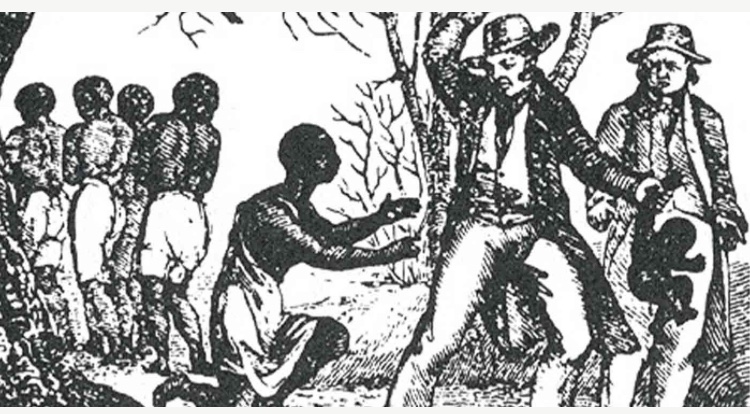
January 21, 1804 ~ Virginia legislature passed a law outlawing all nighttime meetings of enslaved people; such unlawful assemblies were made punishable by up to 20 lashes.
January 20, 1870 ~ Southern Democrats declared the election of Mississippi Senator Hiram Rhodes Revels, the first African American Senator, null and void and argued Black people are ineligible to serve in Congress.
The Bancroft Library, University of California, Berkeley
January 19, 1930 ~ Mobs of up to 500 white people roamed Watsonville, California, and the surrounding towns and farms, attacking Filipino farmworkers and their property for five days after Filipino men were seen dancing with white women.
January 18, 1962 ~ The president of Southern University closed the Baton Rouge. Louisiana, campus, citing ‘disruptive’ student protests against segregation.
January 18, 1771, the North Carolina General Assembly approved the disbursement of public funds to enslavers as compensation for the executions of Black people they held in bondage.
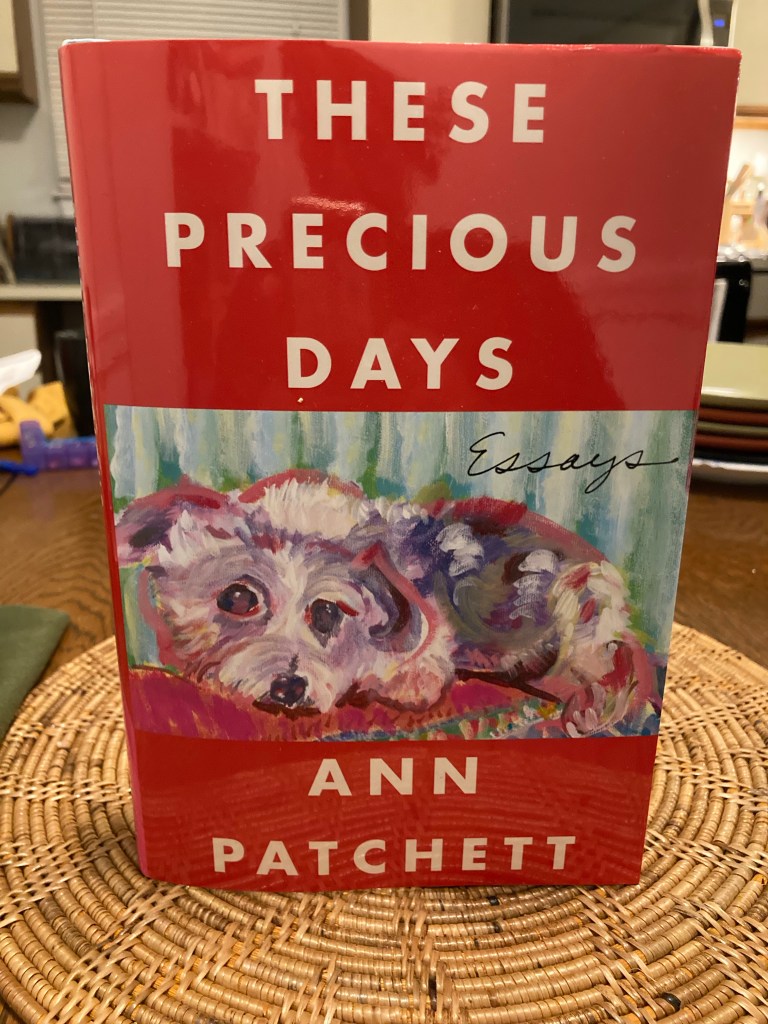
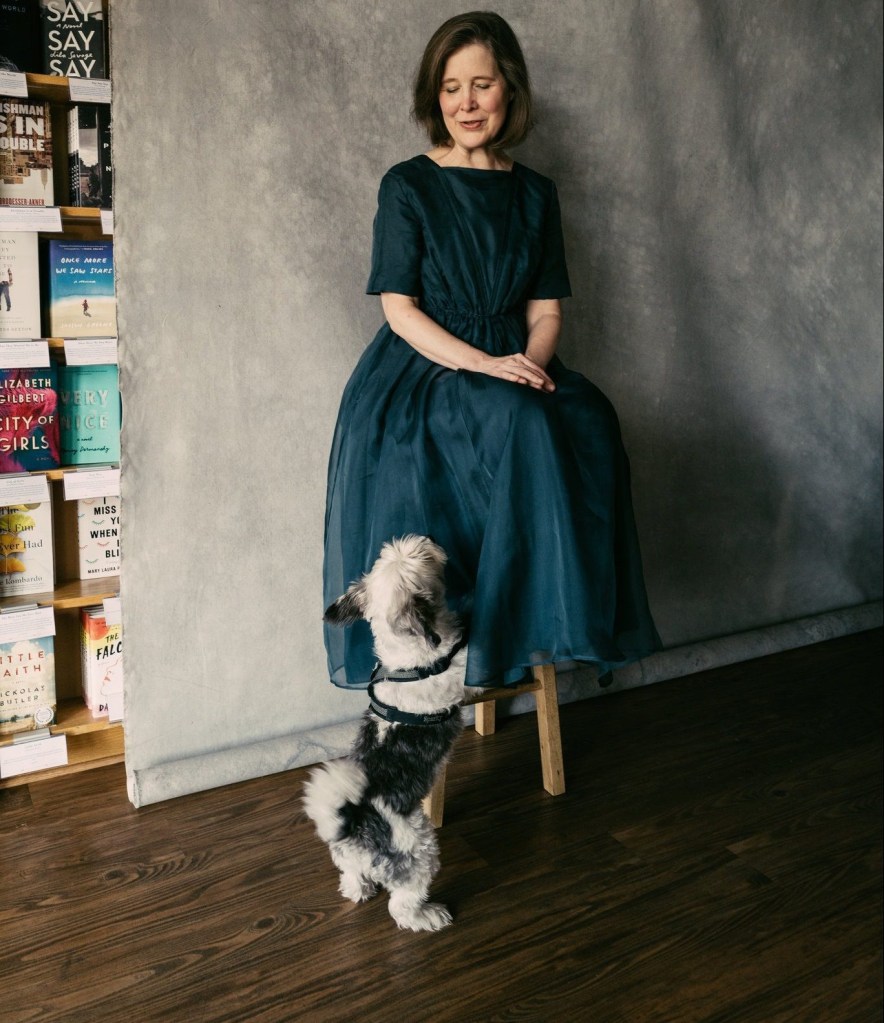
These Precious Days is a 2021 essay collection by American writer Ann Patchett. The 336-page book of 24 previously published essays was revised for the collection. I read this book as a Rivers Faculty & Staff book club assignment. These are my notes.
“Essays never filled my days,” Patchett writes, “but they reminded me that I was still a writer when I wasn’t writing a novel.”
I was a reluctant reader because essays don’t generally appeal to me. I had not heard of Patchett. Her recycled essays are full of well-written examples of privilege and name dropping. Reading them did not cause me to long to read her novels since I did not find any common ground, and yet a few things were interesting.
Ann Patchett and Sparky. Photo : New York Times
Essays Don’t Lie
Her process: Write total book in her head, edit, copyedit, page proofs, book tour. She feared dying while writing every novel because she held the entire book in her head.
She has always written essays for various magazines about things which are true and verifiable.
For this collection, her second book of essays, she looked back at things she wrote in the past few years, took the ones she liked best and reworked, made corrections and polished them up.
Three Fathers
Her mother married three times. She waited until all three men were dead before she wrote about them.
Her birth father did not support her as a writer until she was making a living at it. Her first stepfather encouraged her and wanted to be a writer him self.
“You are a duck, I would tell myself. This is rain.”
“I wrote and read and read and wrote.”
“…love does not need understanding to thrive…my father taught me at an early age to give up on the idea of approval.”
“Rich is a useless word, since everyone has her own definition, but in this case use mine: I had so much money I no longer knew exactly down to the last dollar how much I had. I could give money away without needing it back.”
“To be a writer, you have to like your own company.”
The First Thanksgiving
…”self-reliance and a book, which, as I would later learn, was all I really need.”
“…books can save you, those were the lessons I learned my freshman year of college…”
The Paris Tattoo
An artist’s garret ~ a top-floor or attic room, especially a small dismal one (traditionally inhabited by an artist).
Boulangerie ~ a French bakery, as opposed to a pastry shop. Bakeries must bake their bread on-premises to hold the title of ‘boulangerie’ in France.
Arrondissement ~ a subdivision of a French department, for local government administration. an administrative district of certain large French cities, in particular Paris.
“Youth is its own mystery.”
My Year of No Shopping
No-shopping year – she made a pledge that for a year she wouldn’t buy shoes, clothes, purses, or jewelry because she needed less than she had.
Draconian ~ (of laws or their application) excessively harsh and severe.
“If you want something, wait a while. Chances are the feeling will pass.”
“Not shopping saves an astonishing amount of time.”
“Once I stopped looking for things to buy, I became tremendously grateful for the things I received.”
The Worthless Servant
Hagiography ~ 1. the writing of the lives of saints. DEROGATORY 2. adulatory writing about another person. 3. biography that idealizes its subject.
“I was struck by how often the lessons we learn when we’re young, the things we could never imagine needing, make it possible to meet what life will ask of us later.”
“Homelessness is an exhausting and dangerous state of being.”
“…wake up every morning and meet the world again with love.”
How to Practice
Pouf ~ a large, solid cushion that is typically located on the ground surrounded by other pieces of furniture.
“…over time, the closets and drawers had filled with things we never touched, didn’t want, and in many cases had completely forgotten we owned.”
“This was the practice: I was starting to get rid of my possessions, at least the useless ones, because possessions stood between me and death.”
Ascetic ~ characterized by or suggesting the practice of severe self-discipline and abstention from all forms of indulgence, typically for religious reasons.
Scarab ~ 1. a large dung beetle of the eastern Mediterranean area, regarded as sacred in ancient Egypt. 2. an ancient Egyptian gem cut in the form of a scarab beetle, sometimes depicted with the wings spread, and engraved with hieroglyphs on the flat underside.
“In any practice there will be tests. That’s why we call it a practice – so we’ll be ready to meet our challenges when the time comes.
To the Doghouse
“Influence is a combination of circumstance and luck: what we are shown and what we stumble upon in those brief years when our hearts and minds are fully open.”
THIS—> “I have lived with many dogs I considered my equals, and a couple I knew to be my betters. The times I’ve lived without a dog, the world has not been right, as if the days were out of balance.”
(I miss living with a dog!)
Eudora Welty, an Introduction
I have not read any Welty. This essay did not cause me to want to read any Welty.
Fabulist ~ 1. a person who composes or relates fables. 2. a liar, especially a person who invents elaborate, dishonest stories.
Verisimilitude ~ the appearance of being true or real.
Flight Plan
Patchett’s second husband was a collector of airplanes.
“Repetition was key to learning.”
“Find the good and praise it.”
How Knitting Saved My Life. Twice.
Knitting was a task that was essential to female adulthood in Denmark, Belgium, France and Ireland.
Tavia
“…life is a game show.”
Discomfited ~ make (someone) feel uneasy or embarrassed.
“She had managed to peel off other people’s expectations in order to see what a life that was entirely her own would look like.”
There Are Not Children Here
“…rarest of birds — a commercially successful literary author. “
“Flexibility was what writers got instead of health insurance.”
“People want you to want what they want. If you want the same things they want, then their want is validated.”
A Paper Ticket Is Good For One Year
“It mattered less where we are going and more who we were with.”
The Moment Nothing Changed
“For as many times as the horrible things happens, a thousand times in every day the horrible things passes us by.”
The Night Stand
“I didn’t write in drafts. I worked on one chapter, one page, one paragraph, a single sentence, over and over again until it is right, then I move ahead.”
“…Pandora’s lesson: don’t lift the lid.”
“Foxed” ~ age-related deterioration of paper
“I keep pens in the drawer of my nightstand now, scratch pads, a tiny book light. I’ve found that when some thoughts wakes me, writing it down is my best hope of going back to sleep.”
A Talk to the Association of Graduate School Deans in the Humanities
“All children were feral in the seventies.”
“…manual labor is hard and should not be romanticized.”
“Teaching made me a better reader and a better thinker. I became more conscientious about how I expressed myself, which in turn made me a better writer.”
Eviscerate ~ disembowel (a person or animal).
“As every reader knows, the social contract between you. And a book you love is not complete until you can hand that book to someone else and say, Here, you’re going to love this.”
“…if you want to save reading, teach children to read.”
“…the essence of a liberal arts education is the ability to be flexible and curious…”
Cover Stories
“The covers of literary fiction were almost always printed on matte paper, while the covers of commercial fiction were glossy.”
“…there was something emotionally satisfying about being able to read a book in one sitting.”
“I marveled at the resilience of children for their ability to survive their own childhoods with joy.”
Sister
People assumed that she and her mother where sisters as they both aged.
These Precious Days
“Curiosity is the rock upon which fiction is built.”
“People are not comprised entirely of their facts.”
Derecho ~ Spanish for straight, direct
Misunderstanding is a sin
“When you’re young, you’re getting high, and when you’re old, you’re using plant medicine…”
Coat of Arms ~ reads QUALITY OF LIFE, LIFE-MEANING, OPTIMISM
A year ~ “…an unimaginable unit of time in the life of a child.”
Two More Things I Want to Say about My Father
“I will tell you: as a writer I am first and foremost my father’s daughter. I didn’t operate out of desire to please him so much as a desire not to offend him, and the truth is that the constraints did my work little harm. I found plenty of things to write about that weren’t smoking or swearing or sex.”
What the American Academy of Arts and Letters Taught Me about Death
This essay is full of the names of creatives who are members of the American Academy of Arts and Letters, mostly white and mostly male — 250 at a time and they are replaced as they die. The only interesting thing in the essay is that Gordon Parks, Langston Hughes and W. E. B. Du Bois were members. That made my wonder what other Black folks got picked.
A Day at the Beach
The epilogue of the book tells of the last days of Sooki Raphael.
My 12 Resolutions for 2022 were picked to nurture, feed and grow my emotions to broaden my life as it grows shorter as I age. These intentions are chunked into tasks.
I will transform my resolutions into intentions which will be used to set and prioritize clear, reachable, ***S.M.A.R.T.E.R. goals and chunked into tasks.
1. I will filter all that I see through a lens of love and kindness.
Express gratitude at some point every single day.
I will Shine App check-in to list daily gratitudes.
I will use Headspace All to meditate daily.
I will talk over the high points of my day with my wife.
I will beginning each day with love, grace and gratitude
I will focus on doing things with immediate payoffs like improved mood and energy level as my motivation.
I will be active throughout the day.
I will do three 10-minute bouts of exercise scattered throughout the day.
I will keep trying different types of exercise until I find an activity or workout routine that makes me happy.
I will try high-intensity interval training (HIIT).HIIT is a training style that involves periods of exercising intensely with an elevated heart rate alternated with recovery periods.
I will use strength training increase my body’s muscle mass to increases my overall metabolic rate.
I will eat at more protein.
I will take the stairs.
I will drink more water.
I will drink a full glass of water before bed.
I will drink 3 full glasses of water when I get up in the morning.
I will develop a willingness to accept and grow through times of difficulty and discomfort.
I will learn the difference between giving up and starting over in the right direction.
6. I will cultivate relationships.
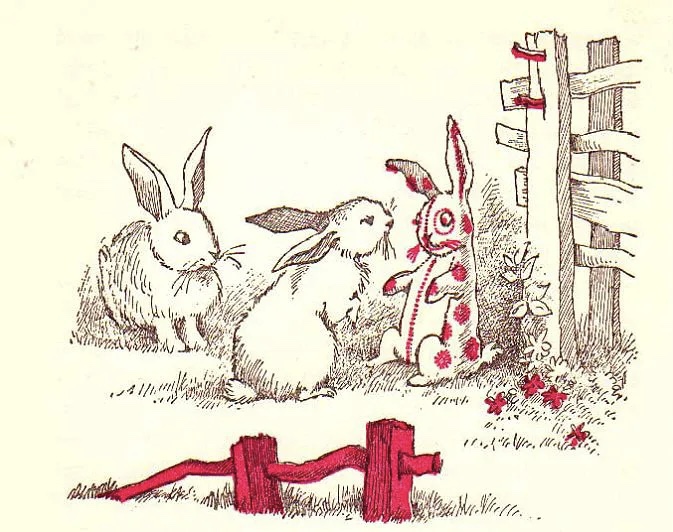
“Real isn’t how you are made… It’s a thing that happens to you.” Maurice Sendak’s little-known 1960 illustrationsfor The Velveteen Rabbit.
I will spend time with kind people who are smart, driven and likeminded.
I will surround myself with people who reflect the person I want to be.
My solitude is important, too.
I will always bring something – wine, flowers – to a dinner/birthday party, even if they say not to.
I will send a voice note instead of a text; they sound like personal mini podcasts.
I will know my value and what I have to offer, and never settle for anything less than what I’ve earned.
I will send postcards from my holidays. I will send them even if I am not on holiday.
I will be polite to rude strangers – it’s oddly thrilling.
I will ask questions, and listen to the answers.
I will text to say thank you and follow up with a handwritten note.
I will say hello to my neighbors.
I will call an old friend or relative out of the blue at least twice a month.
I will politely decline invitations if I don’t want to go.
I will visit my siblings in 2022, as soon as covid allows.
If I do leave early, I will have an exit strategy (maybe slip out unseen).
I will join a community book club.
I will text someone I saw online recently and reconnect one a week.
I will eat lunch with a co-work who I don’t know well or with a lonely student.
I pledge to listen more and talk less.
I pledge to put my frustration aside and work to understand you.
I pledge to be more sensitive and less reactive.
I pledge to act out of respect instead of defensiveness.
7. I will have more art, music and nature in my life.
I will walk outside most days not matter what the weather.
I will walk outside barefoot when it is warm enough.
I will sketch most days.
I will read August Wilson’s Century Cycle again in 2022.
8. I will walk and be more present.
I will walks without my phone.
I will turn off all notifications on my phone except for phone calls (even text messaging).
I will sleep without my phone in the bedroom.
I will sleep without listening to music.
I will try a biphasic sleep schedule.
9. I will cultivate self discipline.
I will fight and win the battles of today, only.
Every week, I will search my email for the word “unsubscribe” and then use it on as many as I can.
I will use small, incremental changes to change everything in the long run.
I will try taking a cold shower (30 seconds to two minutes) before a hot one. It’s good for my health – both physical and mental.
I will remove one box of clutter a week.
I will clear the emotional and physical clutter in my life.
I will pick one surface a week in my home that I can clear entirely (a bathroom counter, a coffee table, a shelf, or a nightstand) and remove everything from it.
I will not buy a single nonessential item. Then, I put that $49 into a savings account. The next week , I will do the same thing.
I will buy secondhand.
I will buy in person.
I will track / log every penny I spend.
I will eliminate one obligation from my life that I do not enjoy or does not further my greatest passions and pursuits.
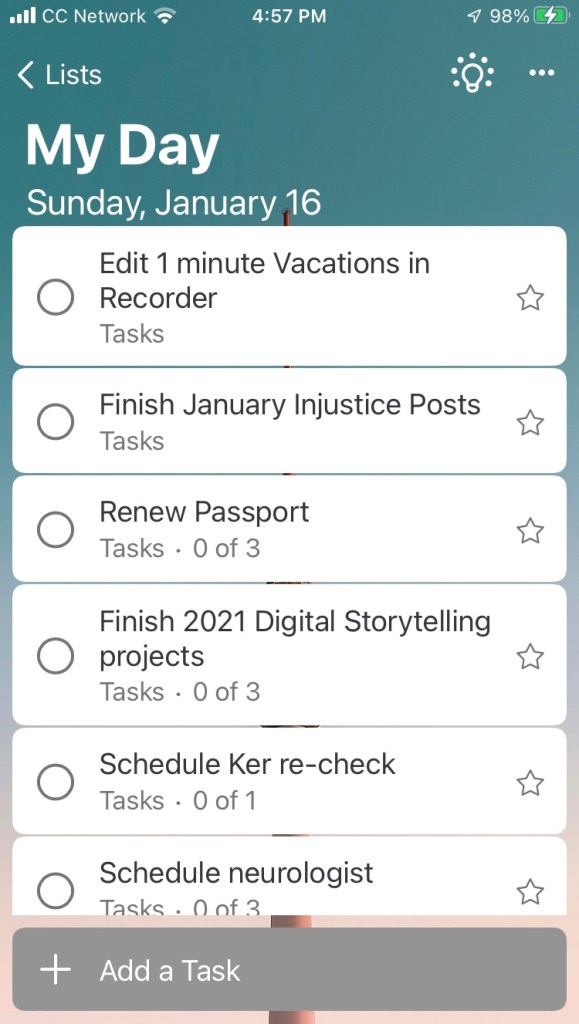
I will make a daily 3-Item To-Do List. 3-item to-do list Every morning, I will write down the three most important tasks that I need to complete that day.
I will not overthink “exercise daily.”
10. I will be like water.
This simply means I will be flexible in both mind and body. It’s about not being rigid and stubborn about my beliefs, practices, understanding, and instead, about being open-minded and able to change and adapt to the circumstances I am put into.
11. I will never stop learning.
I will join my local library – and use it.
I will learn the basics of repairing my clothes.
I will take a Civil Rights class at Rivers.
I will learn to use the woodworking equipment at Rivers.
I will learn figure drawing.
I will play with film cameras and processing.
I will learn to code.
12. I will embrace my mistakes.
I will consider action-taking as a path to learning.
I will experiment.
***Specific ~ (simple, sensible, significant). What? Why? Who? Where? Which? Write the goal down and be as detailed as possible.
Measurable ~ (meaningful, motivating). How much? How many? How will I know when it is accomplished? Write about how you’ll measure your success toward this goal.
Achievable ~ (agreed, attainable). How can I accomplish this goal? How realistic is the goal, based on other constraints, such as financial factors? Look at your goal. Is it challenging enough to spark my interest?
Relevant ~ (reasonable, realistic and resourced, results-based). Is it worthwhile? Is this the right time? Does this match my other efforts/needs? Am I the right person to reach this goal?
Time bound ~ (time-based, time limited, time/cost limited, timely, time-sensitive). When? What can I do six months from now? What can I do six weeks from now? What can I do today? Identify ways that you can reward yourself when you make progress.
Evaluated ~ Schedule time once a week to analyze your progress and accomplishments. Look at what has and hasn’t worked, and make adjustments along the way. Break large, complex goals down into smaller sub-goals. This will stop you feeling overwhelmed, and it will make it easier to stay motivated.
Reviewed ~ Measure progress by breaking difficult or large goals down into smaller chunks, and seek feedback when you reach each milestone.
The Rivers School had over 45 people test positive during the second week of January 2022. That number includes teachers, staff and students. All classes were offered hybrid so students and teachers had the option to join in using Google Meet.








 Relentless Robin