
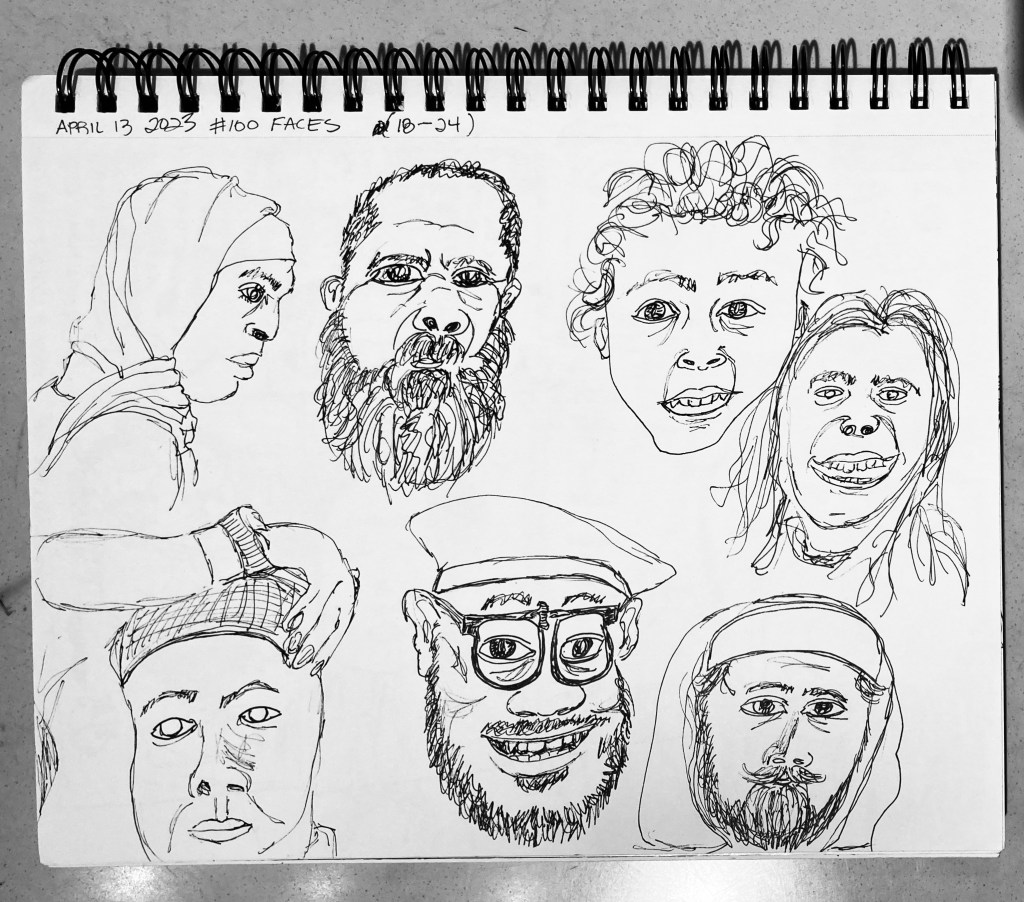

I am joining a quest to draw a 100-faces. I will do them in pen and ink for my first round with a goal of 8 to 10 per day (and per page – so smallish) in a 9 by 12 sketchbook. Then I will move on to more extensive / bigger for another 100.
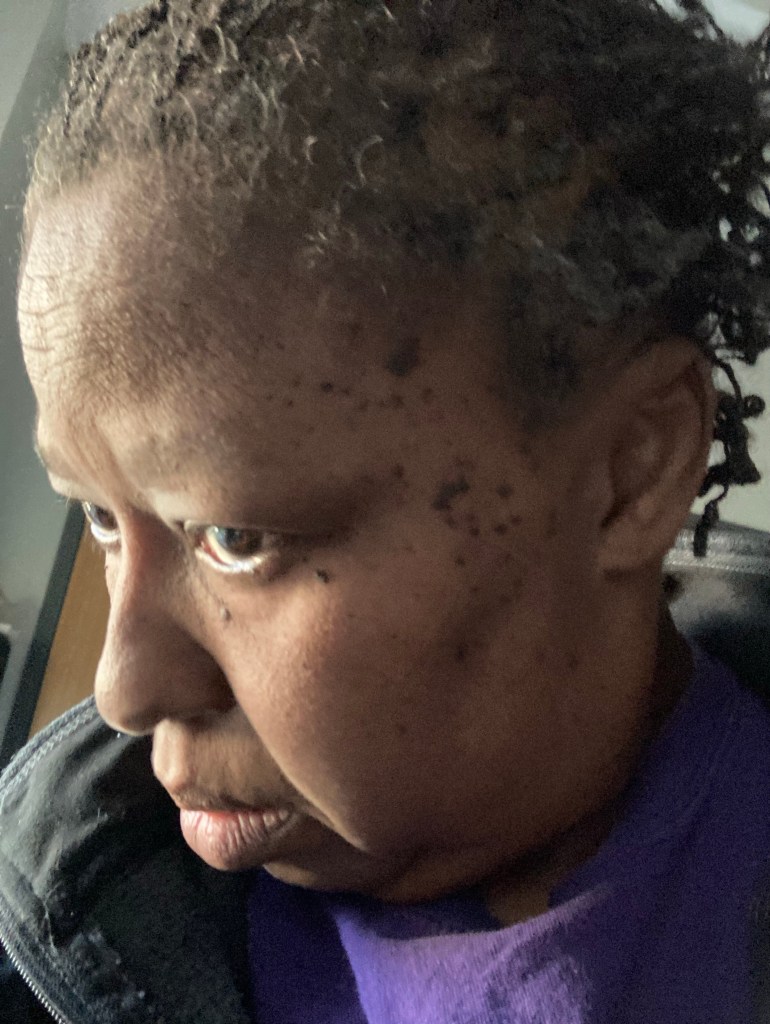
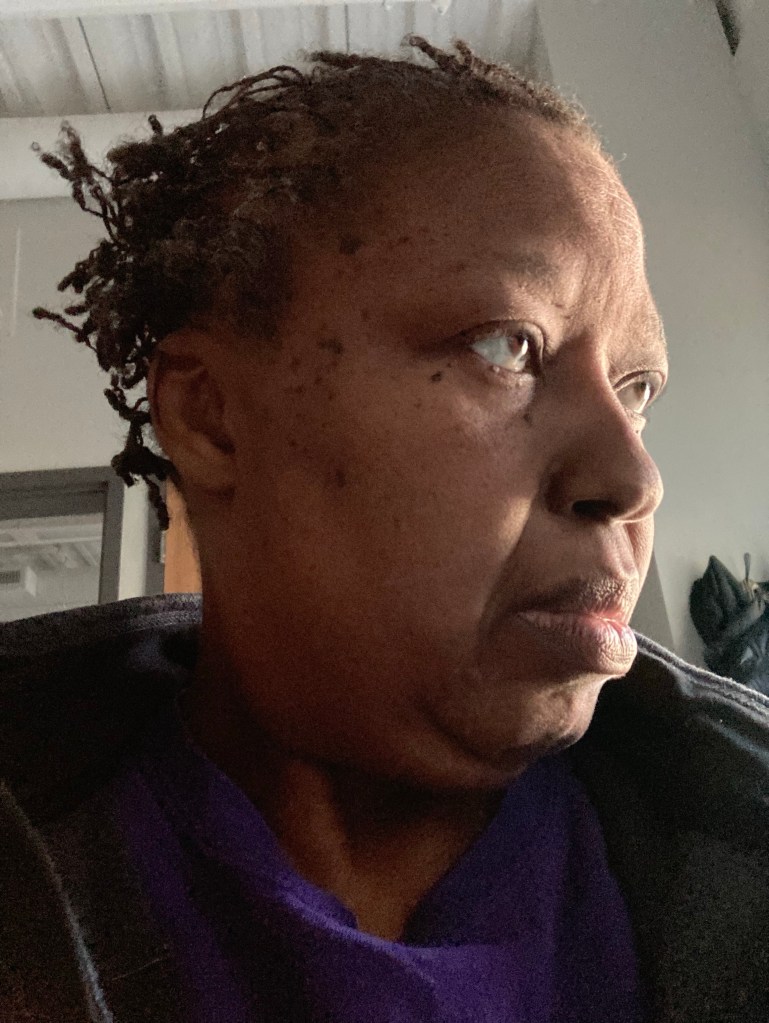
I am also working on doing self-portraits every week but more than just photos. I don’t have a number goal for selfies but I am trying as many mediums and methods as I can.






Class Notes: Theme = the inferred stance taken on a topic of a story. Everything that happens within a story should reference back to a theme.
My Answer: For my Six Word Memoir I skimped on the writing part. I was in “documentary” mind set. I did brainstorm about 25 six word memoirs, and enjoyed the experience. I started shooting a few different films using a few different memoirs.
I did no do much pre-production for the first couple of shoots. I just captured what was going on around me, similar to doing photojournalism. For my final film, I looked at a shot list and tried to collect as many different ones that I could, also documentary style.
I enjoyed the filming and playing with the visual options. I shot so much footage that I did not use or even look at more that a quarter of it. I plan to take seriously a plan that the more I shoot the better I will become at video. I will get back into the habit of carrying a camera and shooting every day.
I am a better editor that I am a cinematographer. I edited this short on my IPhone using an application called InShot. It is what I taught homeschool kids when I was doing workshops because it has a free version. I use Pinnacle (on a large old iPad when I make basketball highlight videos), Adobe Rush (on a small school issued Ipad when I do projects with Rivers middle school kids) and have used IMovie – which I dislike – since Apple released it a million years ago.
My goal for this class (and working through the summer) is to become competent with Premiere. To that end I have several projects that I shot over the last two years that I have not yet edited. I also plan to spend a minimum of 3 hours a week playing with Premiere.
My shooting challenge is holding the camera steady – despite using a steady hand gadget for every shot. When I received comment cards from my classmates about my short, most asked if I considered using a tripod (no because I was shooting in the move documentary style) or a steady hand. I need more practice shooting hand held on the move and may invest in a shoulder mount. I will also play with a monopod and the dolly mounted tripod.
The (fiction) writing part of this class will stretch me and serve me well because it will push me out of my comfort zone.
Please read this adapted excerpt and complete the four brainstorming activities outlined in the text.
Excerpt from Sheridan, Sherri. Developing Digital Short Films.
Beginning the Story Concept Process (p. 18-19) Screenwriting is more like architecture than it is a whoosh of sudden creative inspiration that magically pours out over the pages. Your script is the blueprint for constructing every aspect of your film. Great screenplays are built up in layers, using the types of techniques presented in these first four chapters.
The first step to making a short film involves finding a great original idea to develop into a script. If you do not have the story for your film down before shooting, you do not have anything. By the end of this chapter, you should know the following:
My story: My main character in my short film will be nameless woman, 60ish, living in New England. She wants to get through the day of substitute teaching without losing her mind. I want to explore the relation between this “part time” teacher and a lonely young student who can not seem to get anything right. I don’t know it it is an original idea. It will be filmed from the point of view of the teacher. The camera will never show the teacher only what the teacher sees and hears. It is a short film that I would go to see.
The Most Important Thing: What is the goal of telling a good story? What is the primary goal of any film, play, novel, song, TV show, video game, or animation? Think about this for a moment before you read on; it is a very important point. Most people say that their primary goal is to entertain or make money.
These things are important, but may not happen unless you approach it this way: The first and primary goal of a filmmaker is to evoke a series of strong emotional responses from the audience throughout the entire story.
People also like to be entertained by amusement and surprise, inspired by the character’s noble actions, informed about new relevant ideas, and explore fresh perspectives and insights on life. Above all else, however, you need to get the audience emotionally engaged in the story, to stimulate their curiosity about the characters and events. This does not happen by showing characters crying or screaming at each other.
You engage the audience when you tell the truth emotionally based on your own experiences and original insights about life, in your film.
Review the emotional impacts of your favorite films. What did you feel when you were watching them? When you go to the movies, keep an eye on the audience. See whether you can get an emotional read on how involved they are in the story. Films that don’t do well usually fail to evoke any emotion at all.
Here’s the basic structure of a story that you will want to wrap your short film around to practice applying the techniques in this book: It is a story about a protagonist (lead character) who wants something(goal) that forces them to take action. They meet with an escalating array of conflicts (obstacles) leading to a final climax and resolution.
Do not freak out at this point if you think this classic story structure is dated and boring. Almost all films use this structure, and the trick is finding an original approach.
Character: The actions and reactions of your characters drive the plot forward. Characters create their own realities as externalizations of their inner worlds inn a sense.
Plot: The series of events that happen in the story to the characters.
Theme: Invisible underlying universal-controlling idea, moral message, concept, emotion, issue, essence, or soul of a story.
Conflict: Obstacles that stand in the way of the protagonist in achieving their goals.
Interaction: Characters interacting, connecting, and disconnecting from other characters, ideas, or things. Not all stories are based solely on conflict. Many times in a short film, an interaction or connection occurs that results in a conflict, discovery, or decision. This initial connection often leads to a disconnection and possible reconnection later.
Classic Narrative: Single protagonist with linear time (time frame of events obvious to viewer). Everything you need to know about the story is presented clearly. Cause and effect are clearly observed. Objective viewing experience (viewer conclusions about the story are similar). Focus on making viewers feel.
Post-Modernism: May not have a single lead protagonist. A distortion of time with jumps in time and space (nonlinear time), where audience may not know where in tie events are taking place. May ignore cause and effect completely. Mixing other forms or styles of films together. Strong awareness of unusual camera techniques to tell the story.
Documentary: Organizing information that already exists.
Experimental: No characters even necessary. Nonlinear time. No cause and effect. Viewer understanding is unnecessary; the experience of watching the film is enough.
Create a list of 10 Possible Main Characters (p. 30-31) Focus on creating original ones, not characters you have seen in other movies. These could come from stories you’ve written, sketched, or thought about creating. Some of these characters may be from famous films or animations that you combine with parts of other characters or actors to create new versions. These people could also be based on real people you know or animals, as long as you change them enough to create original screen versions. The goal of this exercise is to be able to see and feel what each original character is about, using as few description words as possible.

Top 10 Film Locations (p.35) What unique locations do you have in your area that might make an interesting film world or setting? Every square inch of Los Angeles and New York City has appeared on film somewhere. Are there any haunted, creepy places in your town? What about historical sites, strange-looking power plants, beautiful gardens, magnificent rock formations, cinematic cemeteries, national landmarks, lookout points, abandoned buildings, strange museums, weird stores, or wacky houses? Where is the best spot in your town to see a sunset? What’s the scariest, happiest, most romantic, most scenic, most diabolical, or most futuristic place within a 50-mile radius of your home? How could you take existing locations near your home and make them seem like they are in a different time or place? You usually do not need a film permit for a monopod camera shoot, and may be able to shoot the scene fast if your actors have been well rehearsed.
MY Top Film Locations (Mine are all on campus)
(Wow! Shots (p.35): Sometimes you will think of a great single shot that turns into a film world or specific scene location. Occasionally, you will see a shot that takes your breath away because it is so visually powerful. Perhaps the composition is superb or the match cut from one scene to the next works perfectly. Maybes it’s just a beautiful scene that looks like a stirring series of award-winning photographs set in motion. You want to include as many Wow! Shots in your film as you can imagine. Make a list of 10 Wow! Shots you have always wanted to see in a movie. Don’t think plot, character, or theme yet. Don’t think about whether you can create the shot yourself or can afford to shoot on location. Indulge completely in your fantasy of having every available resource to plan 10 of the best visual shots you have ever wanted to see on a screen.)
My Wow! Shots
Top 10 Story Flavors (p. 36-37) The following list is designed to help you narrow down the types of stories you are most interested in developing. If you had to pick just one story flavor from the following list as your absolute favorite, which one would you choose? Pay attention to what story flavors you are most interested in exploring with your films so that you can study other similar films for visual ideas. Experiment by combining different flavors to create new ones, such as a science-fiction, obsession-reality show, or a postmodern historical fantasy. Come up with your Top 10 story flavors, and have fun with this exercise. Add any categories that you are interested in exploring that I may have missed.
My Top 10 Story Flavors
Brainstorming for Favorite Subjects (p. 40) What areas of interest fascinate you the most? Answer the following questions to help you come up with a Top 10 list of subjects:
What are your favorite Top 3 favorite books? Create a brief sentence or two about the plot using the story concept sentence discussed earlier. See whether you can find the theme of each story and sum up the unique subject matter or genre element.
My top three favorite books are
My Friend Flicka – It is a 1941 novel by Mary O’Hara, about Ken McLaughlin, the son of a Wyoming rancher, and his mustang horse Flicka. Kenneth McLaughlin is a 10-year-old boy living on Goose Bar Ranch, just out of Cheyenne, Wyoming, with his practical father, Rob; his mother, Nell; and his older brother, Howard. Rob is often unsatisfied with Ken, who daydreams when he should be attending to practical matters; Nell, however, shares her son’s sensitive nature and is more sympathetic.
Mama Day- It is the third novel written by Gloria Naylor in 1988. The story focuses upon the tragic love affair of “star-crossed” lovers Ophelia “Cocoa” Day and George Andrews. The setting of the novel is split between New York City, where George was born and raised and Ophelia has recently moved, and Willow Springs, a fictional community situated on a coastal island on the border of Georgia and South Carolina where Ophelia’s family has lived for several generations.
The Girl with the Dragon Tattoo (original title in Swedish: Män som hatar kvinnor, lit. ’Men Who Hate Women’) is a psychological thriller novel by Swedish author and journalist Stieg Larsson (1954–2004). It was published posthumously in 2005, translated into English in 2008. Larsson asks how responsible criminals are for their crimes, and how much is blamed on upbringing or society. Middle-aged journalist Mikael Blomkvist teams with 20 year old hacker, Lisbeth Salander, to catch a serial killer.
What are your Top 3 favorite hobbies or areas of study? These activities may include adventure travel, sports, arts, collecting, gardening, yoga, watching TV, playing video games, or anything esle you love to do in your free time.
My favorite hobbies or areas of study are
What Top 3 historical events, time periods, or people interest you the most? Explain specifically why each subject fascinates you if possible.
My answer: I enjoy reading books 10th to 18th centuries. I love reading about knights and serfs. I also like reading about the Harlem Renaissance and that era of Black joy. I don’t have a favorite historical event per se but the Black Panther movement fascinates me. I want to know more about Isabel de Olvera, explorer, early 1600s She was born in Querétaro, Mexico, in the late 1500s to an African father and an Indian mother. As a young, unmarried, free mixed-race woman in 1600, she sought permission and protection from the mayor of Querétaro to join an upcoming expedition to New Spain (or present-day New Mexico, Arizona and Florida). Although historians are not sure of her motives — some records suggest that she may have been hoping to assist recently settled families at her final destination — her deliberate preparations for the journey were documented. Isabel de Olvera’s existence as a free woman in the 1600s challenges the narrative that the Black experience in America began only when Africans were forcibly brought to this country and enslaved. Her journey is also among the earliest recorded instances of Black people fighting for liberty in North America, an act of resistance that is repeated throughout history.
Do you have any favorite myths? These types of stories explore events that happened before written history, show patterns, and beliefs that give meaning to life, develop shared ancestral memories, fill the gaps between the unconscious and conscious, examine moral behaviors, and help give groups of people identities. What types of myths are particular to your location or culture? What are the new myths for the 21st century? You may want to just list the types of myths you like, such as Hindu or Native American, and read some books on those subjects if you are really into doing a mythic tale.
My Top 3 Myths My favorite myths are Egyptian, Native American, Aesop’s fables and black folk tales. (African-American Folktales fall into one of seven categories: tales of origin, tales of trickery and trouble, tales of triumph over natural or supernatural evils, comic heartwarming tales, tales teaching life lessons, tales of ghosts and spirits, and tales of slaves and their slave-owners.)
Once your Story Ideas chart is complete, do the following two and a half exercises, in order:
Exercise #1: Create five story concept sentences for short film ideas using the preceding chart. The goal is to think up good, original ideas you would love to see in a short film. Everyone’s chart is going to be different depending on subjective interest. You should see patterns in characters, subjects, settings, and story flavors if you have strong likes and dislikes. Construct your five best story concept sentences in this form:
My Stories:
Story 1: It is a story about a nameless woman, 60ish, from in New England who lives in Elfreth’s Alley in Philadelphia, Pennsylvania. This story explores the subject of homelessness in an animation.
Story 2: It is a story about a12 year old over sized black kid from in New England who lives in The Grand Canyon on the South Rim. This story explores the subject of belonging in a biography.
Story 3: It is a story about a 18 year old athlete from New England who lives in Pulau Tioman, Malaysia. This story explores the subject of belonging in a city symphony.
Story 4: It is a story about a 60ish Palestinian woman who lives in the North End Streets in Boston. This story explores the subject of racism in a journey.
Story 5: It is a story about a 30 something black woman from western Pennsylvania who traveling the world with only a backpack and a camera who lives in Porto, Portugal. This story explores the subject of self identity in a music video.
It is a story about a (Top 10 Character) who lives in (Top 10 film location) This story explores the subject of (Top 10 subject) in a (Top 10 story flavor).
Exercise #2: Take a look at the list of plot goals below:
Now, list your three most recent or favorite films. After each film, list the plot goals. Describe why you enjoyed the film so much. Was it the main character? Did you like the places in which the story took place? Was the ending a total surprise? To start to see where you own style may be heading, you need to figure out what types of films you like. You will most likely be drawn to similar themes, too. Add the theme, subject, and story flavor of each if you can.
MY favorite Movies:
Exercise #2:
My favorite recent films are Woman King, Black Panther and Black Panther: Wakanda Forever.
The Woman King is a 2022 American historical action drama film about the Agojie, the all-female warrior unit that protected the West African kingdom of Dahomey during the 17th to 19th centuries. Set in the 1820s, the film stars Viola Davis as a general who trains the next generation of warriors to fight their enemies. It takes place in what is today the Republic of Benin in west Africa. It wasn’t filmed in Benin, but in South Africa, in the KwaZulu-Natal and Western Cape provinces using locations that look like west Africa. The ending was predictable because of the title.
Black Panther is a 2018 American superhero film based on the Marvel Comics character of the same name. After the death of his father, T’Challa returns home to the African nation of Wakanda to take his rightful place as king. When a powerful enemy suddenly reappears, T’Challa’s mettle as king — and as Black Panther — gets tested when he’s drawn into a conflict that puts the fate of Wakanda and the entire world at risk. Faced with treachery and danger, the young king must rally his allies and release the full power of Black Panther to defeat his foes and secure the safety of his people.The film is set in Africa, although primarily only aerial footage was recorded there; Much of the principal photography of Black Panther was filmed in Atlanta and South Korea. The footage of Warrior Falls was recorded in Iguazu. This is the most spectacular waterfall system in the world, located on the border of Argentina and Brazil in South America.
Black Panther: Wakanda Forever is a 2022 American superhero film based on the Marvel Comics character of the same name. It is the sequel to Black Panther (2018). Queen Ramonda, Shuri, M’Baku, Okoye and the Dora Milaje fight to protect their nation from intervening world powers in the wake of King T’Challa’s death. As the Wakandans strive to embrace their next chapter, the heroes must band together with Nakia and Everett Ross to forge a new path for their beloved kingdom.The sequel Black Panther: Wakanda Forever, released in November 2022, was also mostly filmed in Atlanta. Wakanda and its capital, Birnin Zana, were created digitally via CGI.
Finally, going back to Exercise #1 and your five story concept sentences, choose three and add one or two plot goals to each.
p. 45 excerpt, for some more context: Now that you have an idea for your short film, you need to give the story some structure by thinking of a plot goal for your main character. Take your Top 3 ideas and choose three possible plot goals for each story concept sentence. The three plot goals may relate as a series of goals in one story, or be separate main goals for completely different ideas. Longer films often have several plot goals that change throughout the story depending on the length. The first goal could be to sneak into the aquarium and the second one to get a picture swimming with the rare giant squid. Short films of less than 5 minutes usually only have time for one or two plot goals. Be very specific after you choose your type of plot goal. “To not get caught” needs to be more specific, such as “to not get caught sneaking into the aquarium.” Start to see the film in your head and imagine the different characters and situations emerging.
Exercise #3:
Story 1: It is a story about a nameless woman, 60ish, from in New England who lives in Elfreth’s Alley in Philadelphia, Pennsylvania. This story explores the subject of homelessness in an animation while exploring a new reality/dimension to find the truth.
Story 2: It is a story about a12 year old over sized black kid from in New England who lives in The Grand Canyon on the South Rim. This story explores the subject of belonging in a biography while revolting against an office job.
Story 3: It is a story about a 18 year old athlete from New England who lives in Pulau Tioman, Malaysia. This story explores the subject of belonging in a city symphony while recovering from a past tragedy.
Share your top three story ideas out loud with your classmates. Start in the form of a logline but expand it by also giving us a bit more detail about who your protagonist is, the location and time period, a synopsis of the plot including goals and obstacles, a possible ending, the story flavor, and an overarching theme. You will put it in writing here on Canvas but then present each idea out loud during class.
To help you with theme, please read this Studiobinder article(skimming is acceptable!)
My Answer:
Story 1 Middle School students make my head hurt
A substitute teacher struggles get through a day of bouncing from class to class in the middle school without losing their mind.
The movie is shot from the point of view of the teacher. Now, on campus.
The Theme is the chaos of middle school teaching.
:::::
Story 2 I am living my best life.
A giant grow-man sized 12-year old bulldozes his way through middle school in search of maturity, self-control and friends. Now, on campus.
The Theme is the chaos of middle school being bigger than everyone in middle school, including the teachers.
:::::
Story 3 (no six word memoir yet)
A high school athlete works to be accepted in his new school. Now, on campus.
The possible plots are coming in to a new school as a better player that the current starters or being an athlete in a bastion brainiacs.
The Theme is belonging in a new place.
“Fairy tales are more than true: not because they tell us that dragons exist, but because they tell us that dragons can be beaten.”
– Neil Gaiman
Anteambulo – forerunner; one who proceeds another to clear the way
Atavism – recurrence of or reversion to a past style, manner, outlook, approach, or activity. Derives via French from Latin atavus, meaning “ancestor.” Avus in Latin means “grandfather,” and it’s believed that the at is related to atta, a word for “daddy.” Atavism is a term rooted in evolutionary study, referring to instances when an organism possesses traits closer to a more remote ancestor, rather than its own parents. That sense dates to the early part of the 19th century. The word’s figurative sense is a more recent development. These days one might describe a building that looks like it’s from an earlier era as an atavism, or (though some people might cringe at this) apply the word to activities like reading actual paper books in the age of electronics.
Commonplace book – a central resource or depository for ideas, quotes, anecdotes, observations and information you come across during your life and didactic pursuits. The purpose of the book is to record and organize these gems for later use in your life, in your business, in your writing, speaking or whatever it is that you do.
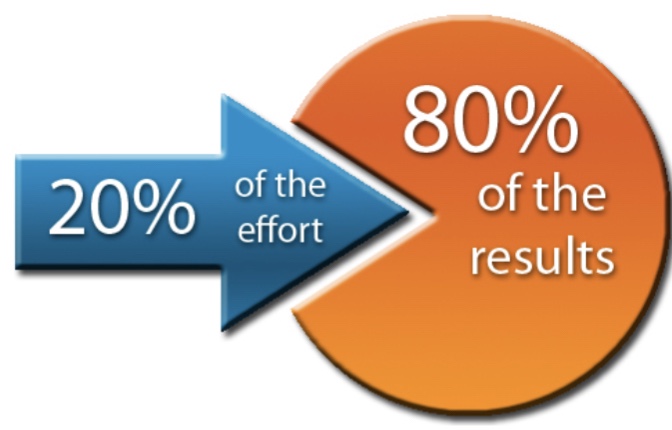
• Shrinkflation: companies cut costs just by changing packaging: shrinking it,
rebranding it as “limited edition,” or both
• Swap-flation: car makers are swapping out premium features like heated seats for more basic alternatives.
• Skimp-flation: hotels are ditching
once standard services like room cleaning, making them “opt in” instead;
even stopped suppling its mini shampoo bottles.
• Robo-flation: companies are using chatbots instead of employees, and labor-strapped restaurants are replacing waitstaff with QR codes.
“Charcuterie” has become synonymous with “food on a board.” The word is derived from the French words “chair” (flesh) and “cuit” (cooked). The term was first spotted on the scene in the 15th century in signage on storefronts specializing in the preparation of cooked pig. Charcuterie is value-added meat—where something is added, be it salt or heat, to enhance flavor and prolong shelf life.
Schadenfreude – German made up of the words Schaden, which means “harm” or “damage,” and Freude, which means “joy.” By definition, schadenfreude means finding joy in someone else’s misfortune. The Opposite of Schadenfreude is Freudenfreude, the joy we derive from others’ success.
The “invisible tax” on teachers of color (Modan, 2022). Educators of color sit on committees on equity and racism, advise student clubs and affinity groups, and feel pressure to speak on all things related to equity and culture. But there is a lack of compensation for those sometimes-invisible extra tasks. Many of the tasks educators of color are engaged with are decidedly leadership activities (for example, participating and leading equity teams, working with student clubs, and specifically supporting both colleagues and students of color). School systems and leaders must formally recognize this type of leadership as an official role with pay and professional learning. This would legitimize and formalize the work often being done behind the scenes. Absent that recognition and support, this work is accomplished voluntarily and adds to the extra burden.
Signature – a divided section of pages in a book that are sewn to the spine.
Visual journal – a mixed media project that uses a hardback book as a base, sometimes referred to as altered books. Work directly in the book using paint, colored pencils, collage, markers, and whatever materials you have access to, to create works of art inside the book. Art journaling is a great way to experiment with materials. At a minimum you need a used hardback book with non-glossy pages, a stack of magazines, scissors, and glue.
Real estate investment trusts (REITs) own real estate properties that generate income, equity, or both. There are public and private REITs, which trade on and off the stock market.
Kunsthalle, or non-collecting museum
The meaning of “WOKE” is literally “aware of and actively attentive to important societal facts and issues (especially issues of racial and social justice).” If ‘woke’ means favoring racial and social justice, then pushing against ‘woke’ means opposing racial and social justice. LEGEND reminds us that the fight for dignity and for social justice is never easy and never over.
Analogies help us 'relate the unrelated' to increase understanding. Analogies prove useful in science and discovery. Thomas Edison discussed imagination, persistence and analogy as keys to inventing.
“See one, do one, teach one.” Medicine is famous for teaching by demonstration, imitation, and education. We know Coach Wooden’s recommendation for EDIRx5. Explanation, demonstration, imitation. repetition x five.
Beat BURNOUT

High performing leaders ask themselves these 6 questions every single day:

Are my people getting better? How do I know? How am I assessing their development?

Do I gather feedback and evaluate performance? Am I self-aware? Team-aware?

Am I focused on the process or the outcome? Am I focused on consistent improvement or just on the bottom line?

Am I developing quality, meaningful relationships with my people? Do we just talk work or do we talk about life?

What have I done recently to work on my craft? How much time do I put into my own professional development?

Am I having fun? Or am I feeling burned out?
I did not make any new resolutions for 2023. I did reflect some that I made going into 2022 that I held on to for all 12 months and have continued.
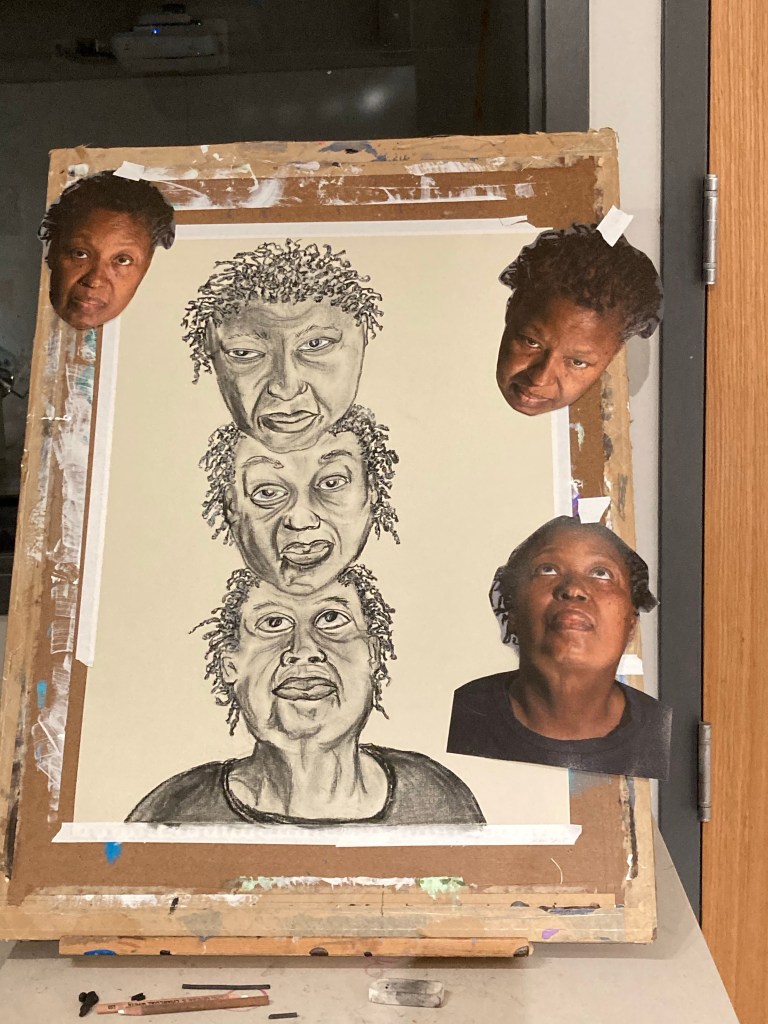
Did you stick to your 2022 goals, new ones for 2023? Have you stuck to them as we end the second month of 2023?
What strengths did you exemplify last year? I am happy with my stick-to-it ness when I comes to finishing classes, filling sketchbooks, building relationships, saving for retirement and my health.
How did you surprise yourself? I surprised myself by my consistent attention to my health and with my commitment to drawing, reading and writing everyday. I read over 250 books in 2022 until I stopped logging them in August.
What were some personal highlights from last year? Mine were dropping about 60 pounds, taking drawing, audio storytelling, black literature and social justice classes.
What are some of the reasons you were proud of yourself last year? I am proud of the improvement that I have made in the technical part of drawing and with how much money I have been able to save once I cut out (most) impulse buying. Books are my addiction.
Brainstorm ideas for a screenplay using the “Personal Menu”. Choose 3 different things you put on the list and think of times in your life that illustrate each. Write about the moment or time in your life when you realized each thing was true. Start in class and finish for homework.
My Answer: This does not quite fit the assignment. The screenplay is for a fiction project that will be produced into a 3 to 5 minute short film. I’ve never written fiction before so I am struggling to come up with ideas related to my personal menu. I do like some of my six word memoirs.
These are candidates:
“Middle schoolers make my head hurt.”
“Learn. Engage. Question. Fight. Have fun. “
I think I can use either to write a script and film around middle school students.
They are only related to my Personal Menu in that I listed coaching, teaching and relationship building as part of my menu.
Find and watch commercials for three different products/services. As you watch each, identify the following elements (list form is fine!):
For each commercial you are writing about, please provide a link to view it (and a title if possible).
Commercial 1: Budweiser 2017 Super Bowl Commercial | “Born The Hard Way”
The story centers Adolphus Busch, Anheuser-Busch founder, and his journey to America in pursuit of his dream to open a brewery. The commercial begins with Busch in a dark bar and ends with him in a dark bar shaking has with Eberhard Anheuser in a neighborhood bar owned by Anheuser in the 1850s.
All characters are middle age, white and, all but 2, masculine presenting.
The characters, locations and scenes include:
-A 1850s bar with three white men
-Mid Shot of Busch on ship
-Close up of Busch’s hands writing in a journal
-Ship on stormy sea with wild waves and high winds
-Several white men in an transatlantic ship being tossed from their bunks during a storms
-A white, male, middle aged doctor stitching Busch’s who speaks in German (with English subtitles)
-Close up of Busch’s entry card being stamped
-Close shot of Busch looking at his entry card
-Mid shot of white man bumping Busch’s shoulder and yelling in his face “Go back home!”
-Crowd of white people, mostly adult and male, on the 1850s streets of New York City walking around Busch
-A detail shot of a paddle wheel coming out of the water
-Mid shot of Busch standing at the boat rail read his journal
-Close up of open journal
-Wide shot Busch and a BLACK man on the rail of a paddle wheel steamer at dusk
-Several white men jumping from the burning steamer
-Detail shot of ship burning
-Busch in the water with burning ship in background
-Art shot of longboat full of backlit people shot through reeds or cattails
-Long boat full of white people including two women framing Busch who is reading his journal
-People walking in the sloppy mud shot from the knees down (camera at knee level)
– Back of Busch as he stands on a street watching white people walk by
-Busch’s face as he stands on a street watching white men walk by on the muddy streets of 1850s St. Louis
-Mid shot of Busch(facing camera) standing in bar
-Camera zooms out to show a wide view of three white men in a dark bar
-Mid shot of Busch(back to camera) standing in bar
-Close of Busch’s journal open on the bar
-Busch and Anheuser centered in a dark bar shake hands
-Credit
Length of commercial is 1 minute with at least 27 scenes.
Target Audience is beer drinkers who watched the 2017 Super Bowl.
Last year, 72% of homes with TVs in use on Super Bowl Sunday were tuned into the Super Bowl telecast, drawing an average of 99 million viewers. Adults ages 44 and under are the largest part of the audience. The bulk of American football fans are a combination of male and female sports enthusiasts who live in rural areas, small towns, or subdivisions outside mid-sized cities.
Of note: Anheuser-Busch advertises the Budweiser brand heavily, expending $up 449 million in 2012 in the United States alone. [1]Presenting Budweiser as the most advertised drink brand in America, and accounted for a third of the company’s US marketing budget.
[1] “Infographic: Meet America’s 25 Biggest Advertisers”. Advertising Age. Detroit. July 8, 2013. Retrieved February 16, 2017
[2] “Anheuser-Busch InBev’s advertising spending in the United States from 2009 to 2014 (in billion U.S. dollars)”. statista.com. Statista. n.d. Retrieved February 16, 2017.
Commercial 2 Full Pepsi Commercial | SuperBowl 2019 | More Than Okay
At the beginning of the ad, when a customer asks a waiter for a Coke and he replies, “Is Pepsi OK?” Celebrities Steve Carrell, Lil Jon and Cardi B tell the server that Pepsi’s “more than OK,” all of whom have signature versions of the word “OK” in their catchphrase repertoire.
The name “Coke” has become universally and synonymously for any brown bubbly drink similar to Coca-cola. (Though Coca Cola holds the most market share, Pepsi has been around for over a 100 years is still has a loyal following. )
The ad has female presenting and male presenting featured characters . There is one female presenting Latinx and one male presenting black among the 15 identifiable actors.
The video was shot in one location, a diner, with about 35 shots and runs 59 second.
Notes: Celebrity Effect – the ability of famous people to influence others. Companies can use that star power and influence to boost their own products and services.
I had no idea who the celebrities in the commercial are so looked them up.
Commercial 3: 84 Lumber /Super Bowl Commercial 2017/ The Entire Journey
This is the full, uncut 84 Lumber Super Bowl promotional film. The ad was shot in the desert, in a house, in a small village and at the Border Wall. There are about 40 scenes, if different parts of the desert are “scenes.”
A mother and daughter’s symbolic migrant make a harrowing journey towards becoming legal American citizens, and then confront a giant wall.
During the trek across the desert, the daughter collects scraps of fabric as they traveled, so she could eventually stitch them together into an American flag.
They find a door in the wall and walk through it, as text appears onscreen: “The will to succeed is always welcome here.”
The ad was banned from the Super Bowl broadcast.
The main characters are a 30ish woman and a child who appears to be 6ish. They are from Mexico. The choice to depict Mexican characters was deliberate.
The commercial runs 5:44. 84 Lumber said that its Super Bowl commercial was intended to be part of a year-long recruiting campaign to get more workers. Ad Age quoted Maggie Hardy Magerko, owner of 84 Lumber, as saying: “We need to hire and train people differently. We need to cast a wider net, and to let the world know that 84 Lumber is a place for people who don’t always fit nicely into a box. We want people interested in creating their own path.”
What is your favorite feature-length movie? Identify a single scene from that movie that could stand on its own as a short with a beginning, middle, and end. Explain why.
My Answer:
Black Panther /2018 / PG-13 / 2h 14m
Marvel Studios’ Black Panther – Official Trailer
T’Challa, heir to the hidden but advanced kingdom of Wakanda, must step forward to lead his people into a new future and must confront a challenger from his country’s past.
Director: Ryan Coogler
Writers: Ryan Coogler, Joe Robert Cole, Stan Lee(based on the Marvel comics)
My favorite movie is Black Panther. The second scene could stand alone as a short movie since it has a beginning, middle and an end.
Beginning – The son sees King arrives
Middle – King and kills his brother
End – The son finds dead dad
During his time as King, part of Wakanda’s vibranium cache was stolen by Ulysses Klaue, leading to T’Chaka discovering that it was his younger brother N’Jobu who had aided Klaue. In an attempt to arrest N’Jobu, T’Chaka killed him and abandons N’Jobu’s son Erik in order to prevent the Wakandan people from learning the truth.
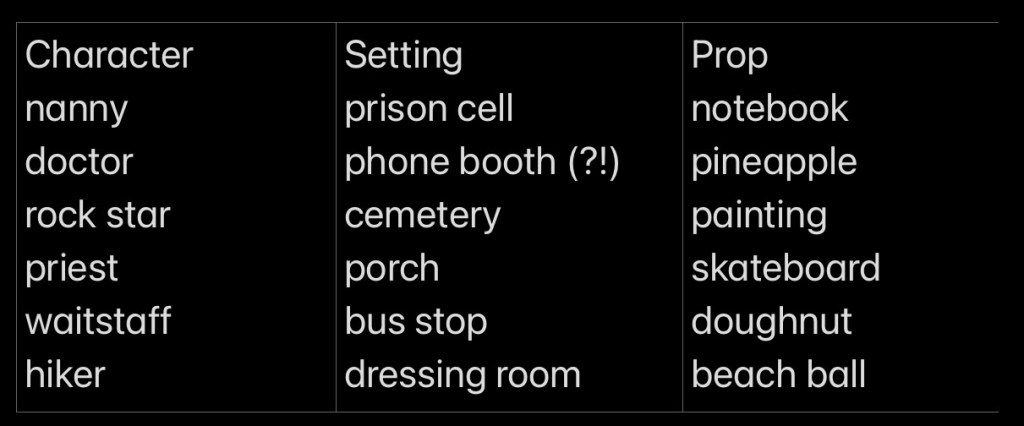
My answer:
The old cemetery was a curious sight for the Hiker to come upon while walking the Appalachian Trail. It was tiny, ancient and nearly consumed by tees, brush and earth.
The Hiker stepped inside the pitted iron fence and lichen-encrusted stonewall and sat down on a grave and leaded against her overstuffed backpack.
“I wonder how long since anyone was buried here?” she wrote a tattered blue notebook and daydreamed.
My Reflection:
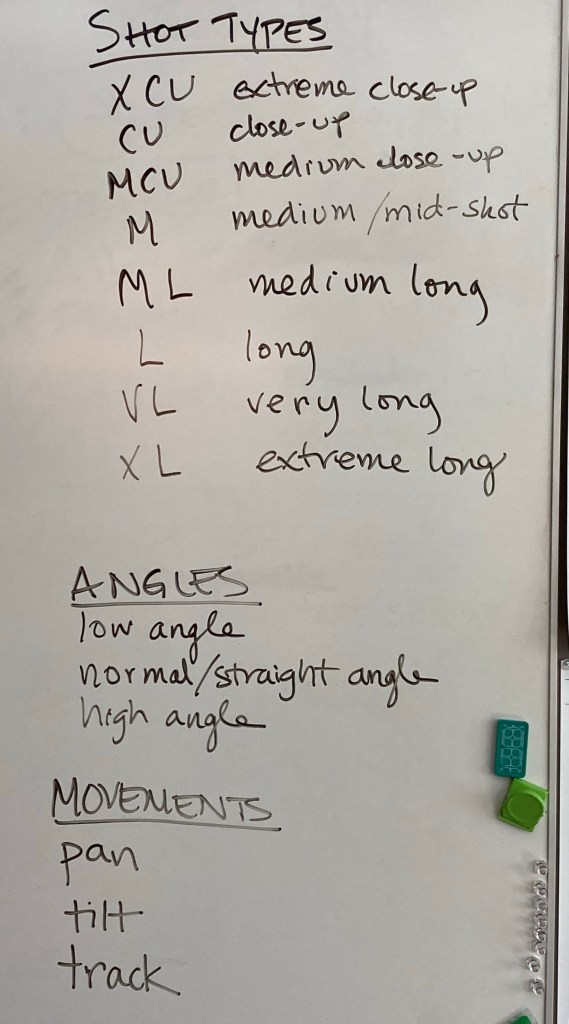
I shot three different SWMs but was not happy with my collection of shot types, shot angles and camera movements for any of the three.
When the teacher listed all the options on the board showing a host of options, I realized I needed more variety in my footage. Art class was low-hanging fruit since I spend large parts of my day hanging out there.
I shot most of footage yesterday and it edited last night on my iPhone SE (2020) using the InShot app (while laying in bed).
The voiceover is a clip from the art teacher’s advisory recorded Jan 2022, when I was collecting 60-second sound bites for another project. I found the clip by sorting through my collection. My second choice would have to record a minute of myself talking about art. The “thanks for watching” is has be my standard closing for a few years. I need an updated, more professional one.
As part of my personal growth in 2023, I am taking a filmmaking class at the Rivers School in Weston, Massachusetts. The class is taught by Sophie Lane.
Filmmaking is about communicating ideas through audio-visual means. In this class I will practice visual storytelling that is personal and compelling and learn to connect with my audience in impactful and meaningful ways.
When I minored in filmmaking in college in the early 1980s, we shot film, cut it in pieces and taped it back together to edit it. The sound was recorded on a reel to reel tape deck. The sound track was synced to the film. I am looking forward to learning digital skills such as editing video using Adobe Premiere.
CLASS NOTES: Filmmaking follows a formula which becomes the spine of your project. You plug your creativity into the process.
Fixed focus lens = Prime lens
“Zoom with your feet.” Ms. Lane
*Practice shots
When building your projects, clips should be 3 to 5 seconds. You can tell a lot of story in 2 minutes.

As a warm-up project for this class, each student will write, film, and edit their own six-word memoir.


Pre-Production Checklist

Title of Film: I am enjoying art these days.

Film Director: Robin Sallie

Filming Date: Jan 30, Jan 31, Feb1, some vintage footage

✓Storyboards Complete (in sketchbook)

Crew: Robin Sallie

Cast: Art students and Mr Nesbit

Locations: The Rivers School, Weston (Art rooms)

Props: none

Lighting: Ambient, RGB Panel Pro

Audio: voice over

*Equipment: iPhone SE 2020, Canon T8i, Sony Handicam, Lavalier Lapel Microphone Omnidirectional Condenser Micophone for cellphone, Monopod, Tripod, plastic camera frame, 18-55 mm lens, triple shoe mount (for light and micophone)
FINAL PRODUCT REQUIREMENTS:
TENTATIVE DUE DATE: Thursday, Feb.9, at the end of class for an in-class viewing party on Monday
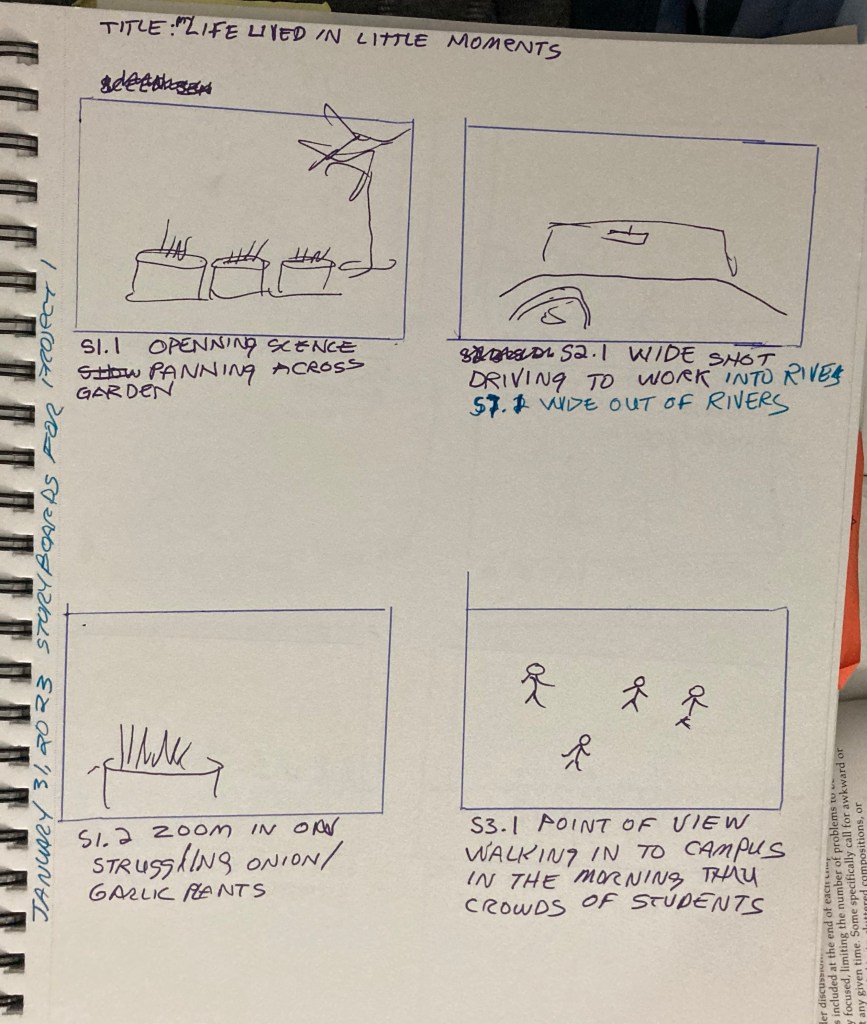
Key parts of a storyboard
Each scene has a title that includes a scene number, and a shot number. The title for Scene 1, Shot 4 would be S1.4.
Each shot in a film has a storyboard panel showing one specific action or moment.
A sequence is multiple shots to be filmed at the same time or at the same location to make up the same scene.
The caption under each panel is a description including details such as camera movements and shot types.
Logline, or log line, – a brief (one to two sentence) summary of a movie, tv show, etc. that hooks the reader in and describes the central conflict of the story. (Note: a logline is not a tagline nor is it a synopsis.)
A strong logline describes the protagonist with strong adjectives, gives the protagonist a clear goal, uses irony, increases the stakes and may break convention.
Formula: When [INCITING INCIDENT] happens, [OUR PROTAGONIST] decides [TO DO ACTION] against [ANTAGONIST].


MY NOTES: I need to practice writing Loglines. Mine are weak. I don’t think I watch enough movies or television to do them well.

Tagline – a short text which serves to clarify an idea for, or is designed with a form of, dramatic effect. Many tagline slogans are reiterated phrases associated with the film. Movie taglines are designed to get audiences to want to see your movie.
The main difference between logline and tagline is that a logline is a screenplay’s concept written down in one or two sentences, whereas a tagline is a short text that introduces the brand message of a finished product.
Synopsis – typically a one-page document that summarizes your film. It contains the film’s title, genre, logline (a one-sentence summary), and a five-paragraph explanation of the film’s storyline, major plot points, and key characters.
My Notes: Practice camera movements and shot types. Consistent results comes from consistent effort and consistent discipline.
Writing About Film: Terminology and Starting Prompts. Learn this vocabulary.
Success can be learned. Change requires measurement and longitudinal tracking. Darren Hardy writes, “Winners are trackers” in The Compound Effect.
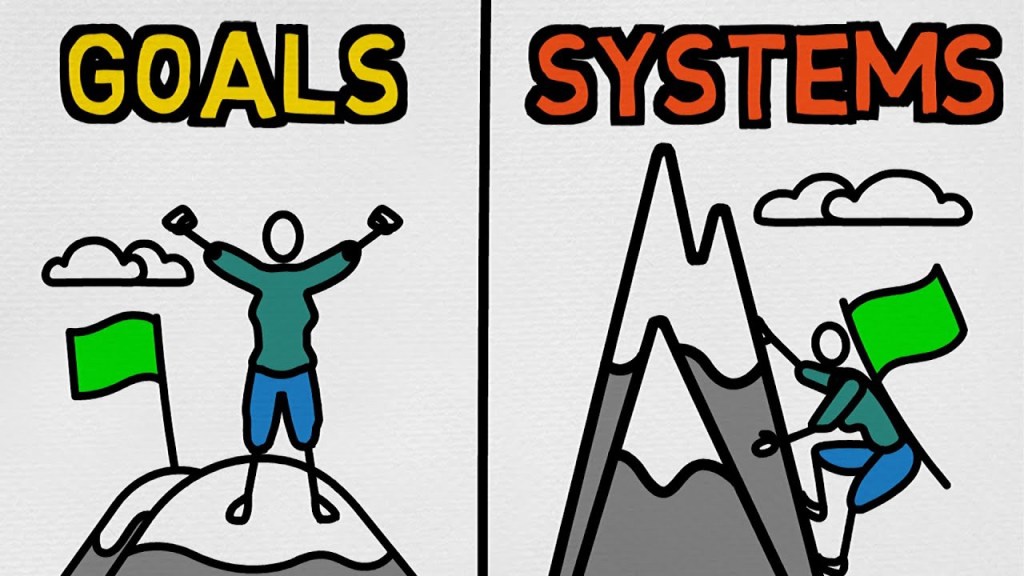
Goals are about the results you want to achieve. Systems are about the processes that lead to those results. Systems are almost the antithesis of goals, in that they’re entirely about creating a repeatable set of actions instead of considering the overarching goal that they’re working towards. If goals are the macro, systems are the micro. They’re how you achieve your goals.
writ of replevin – a court order to return or release unlawfully obtained property
Betrayal is the opposite of love. Love is at the center of a mercy.
~ Toni Morrison
Exercise after eating for blood sugar management.
Build products (or websites) for users; don’t make them figure out which department in your organization does what.
Lemma ~ a subsidiary or intermediate theorem in an argument or proof.
“Unchurched” ~ people who are Christians but not connected with a church. In research on religious participation, it refers more specifically to people who do not attend worship service
Stotinka ~ a minor coin of Bulgaria, the 100th part of a lev.

Adyta ~ the most sacred place of worship in an ancient temple from which the laity was prohibited.
Laity ~ all the people involved in the work of a church who are not members of the clergy, monks, or nuns.
Salacious ~ having or conveying undue or inappropriate interest in sexual matters.
Gomuti ~ a Malayan palm (Arenga pinnata) with feathery leaves and a sweet sap from which a crude sugar and an alcoholic beverage, arrack, are made.
Arseniuret ~ old name for arsenide From Latin arsenicum, arsenic + -uret
Kahikatea ~ a tall New Zealand coniferous tree, Podocarpus dacrydioides, valued for its timber and resin.
Alsike ~ a European clover (Trifolium hybridum) with white or pinkish flowers, grown for fodder.
“irrational expectations” — when people collectively believe in something they know is collectively false.
I was made for the library, not the classroom. The classroom was a jail of other people’s interests. The library was open, unending, free.
Ta-Nehisi Coates
A portfolio is a way for you to showcase who you are, what skills you have, and most importantly the work you’ve done. These are the non-negotiables of any portfolio:
The act of reading a book is the best example of distance learning.
Neil Postman
Wait until age 70 to take Social Security retirement benefits. Retirees who wait to claim can get hundreds of dollars more each month than those who take benefits early.
If you don’t formally request your Social Security benefits, you won’t get it.
Detach yourself from things you don’t need. Spend liberally on things that bring you lasting joy, and cut out expenses for things that don’t.
FOMO – Fear Of Missing Out
The public is indoctrinated to believe that skills are valuable and reliable only if they are the result of formal schooling.
Ivan Illich
Types of Income Streams
Elevenfold By a factor of eleven.
I keep six honest serving-men (They taught me all I knew);
Their names are What and Why and When And How and Where and Who.
I Keep Six Honest Serving-Men (following the story “Elephant’s Child” in “Just So Stories”) by Rudyard Kipling
“The sculpture is already complete within the marble block, before I start my work. It is already there, I just have to chisel away the superfluous material.” ― Michelangelo
 Relentless Robin