I am taking Audio storytelling for journalists: How to tell stories on podcasts, voice assistants, social audio, and beyond” from the Knight Center for Journalism in the Americas at the University of Texas at Austin. These are my notes from the second week.
Audio is amazing at communicating emotion. The information in an audio story can’t be as dense as what’s in a print story. Your focus has to be crystal clear.
What is your focus? What is at stake? What is the central tension in your story? Who are the characters needed to tell the story? What are the scenes you’ll need to bring the story to life? It’s your focus that helps you figure this all out.
Ideas stories – What is the central question? The central question is also a focus. This is best for more simple newsy stories or maybe explainer type projects.
A good audio story is about a question and a quest to answer that question. Good stories are about a person engaged in an action that has a purpose, doing something for a reason.
Focus on the voices to appear in your audio story and what scenes are needed to illustrate what the person is doing and what are the other voices or information that’s needed to explain the reason, which you can also think of as the impact of what the person is doing. Again, the format is someone doing something for a reason. That person who’s doing something is almost always the main character in your story.
Knowing your focus makes doing interviews, collecting tape, writing will be easier and faster. If you know what your story is about and what it’s not about, your focus is your roadmap.
Different interviews will play different roles in the story you’re creating: main characters, expert voices, people who are impacted, etc
Think about what each person you talk to needs to contribute to the story and what parts of your central question or focus statement they can help illuminate.
To do a good interview, you have to know what you plan to do with that tape that you collect. Are you doing an interview that will be in your story as a conversation between you and the person you’re talking to? Are you looking for soundbites to use interspersed with narration? Or are you doing a non-narrated story, like an audio diary or first-person story? Sometimes in longform storytelling, we’re using a mixture of all of these techniques, but having an idea which form will make up the bulk of your story is really helpful.
Write out a plan as to whom you’re going to interview or talk to and what sort of tape you need. Will it be a conversation or a two way, a nonnarrated or audio diary style piece? Are youcollecting soundbites by asking open-ended questions? Are you asking a lot of how and why questions?
Your job is really to get your interviewee talking about the things you want to know about. A little pro tip, at the end of one of these interviews always ask, is there anything else you’d like to tell me about this topic? Because that answer is often your best tape.
Conversational interviews – create a story arc that happens and unfolds over the course of the conversation to tell the story. You’ll need to go in knowing where you want your interviewee to start the story and ask a question designed to do just that. Then you’ll need to know where you want to move the story to develop some tension and eventually move things to where you want the story to end. Your questions may need to provide some information in order to move the story along, provide some context or position the interviewee to tell you just what you need them to tell you.
Story questions: Tell me the story of when x happened? Ask your interviewee to set the scene because you want to get details that will help your listeners visualize what’s happening.
Be silent when you are interviewing. Ask your question and then seriously bite down on your tongue between your teeth. It reminds you to stay quiet until it’s really time to say something meaningful. Nod your head and make really direct eye contact.
Doing a good interview really does take some planning and strategizing. Take the time to think about what information you need from the person you’re talking to for your story and ask questions that are designed to get them to share that information with you and again, knowing the focus of the story is going to help you do that.
Write for the ear, not the eye. One idea per sentence. Simple, short subject verb object sentences. Information in a slow, steady pace. Ears hate numbers.
Learn to write for the ear and for audio by talking about your story. Say it out loud while you are writing. Avoid big, fancy words. Use language that you would normally use in a conversation.
It’s really important for your story to start strong. Put your best stuff first. Don’t save good things for the end. Use the beginning of the story to make sure someone’s invested and really cares about your story.
Reengage people periodically throughout the story by reminding them of the stakes, foreshadow a development and subtly remind them who the characters are. People get distracted easily.
Make your scripts clear. A script lays out everything that’s going to happen in the episode, and it clearly shows what audio is what. A script needs to do two things. Be easy for your voice talent to read and clearly identify what audio elements happen, when and where.
There are three main elements of a script: Narration or tracks, interview clips, which are also called actualities or acts, and sound. The narration is the voiceover. Actualities are the soundbites from your interviews or maybe big chunks of your conversation with someone. Then there’s the other sound or the sound design. This could be archival material, background sound or ambi, ambiance, sound effects or music.
Layout script – use all caps for your actualities and mix case for your narration tracks. Caps help us read out loud more smoothly.
Looking up from the page as if into the eyes of our listener does something that changes the sound of our voice ever so subtly, and it helps us sound like we’re really making eye contact with the person listening.
If a script included names like Rund Abdelfatah <RUN-d AHB-dell-fah-tah> and Ramtin Arablouei <<RAHM-teen ARAB-loo-ee> — I’d provide a pronouncer ….and likely even bold them to make it apparent to you that you may want to practice!
Amb, Ambi, or Ambiance. That’s basically the sounds that happen when you are in the field. Sometimes it is called Nat Sound or Natural Sound or just Sound. Sometimes it is even called Field Tape
Narration or Tracks is what the narrator or host reads. Sometimes in a script my part would be labeled “narrator” or perhaps labeled with the readers name.
Clips from interviews are sometimes labeled just with the guest’s name, sometimes they are called AX or Actuality.
Sound effects are usually labeled SFX. And music is music, unless it is the show theme and then it is Theme.
The project has to be edited and fact checked. The editor is the first ears on the project. They are always using their ears first.
First edit: listen 100 percent with eyes closed and taking notes. Listening for big structural problems. Here is what is working. Here what isn’t. Here is what has to happen next. The editor needs to here the story before they look at the script.
Each time you edit you have a different purpose. First edit you look at like structure, the right voices, emotion and if there is actually a story. It is linear process in which you go from big macro questions to micro questions. You refine each time so that that each time you edit, you have a slightly different purpose.
Macro questions – Are we making a clear point? Do we have a strong purpose to this story? Is our structure right down to smaller bore? How are you saying things? Is this written for your voice? Is your tape working? Do we need more or less of a a person?
Micro questions – smaller things that are easier to fix such as worrying about a couple of words here and there.
Audio journalism is one of the best mediums for feelings.
First structure, then really listening for the wording, then listening for facts and last we’re listening for, pacing and rhythm because there’s this musical quality to audio which is about sound design.
Signposting and resets: showing of your hand. There’s so many opportunities for your listener to get lost, and so signposts are anything that helps the listener find their way. Sometimes it’s sort of a recap of where you’ve been and a point telling you where you’re going.Such as quick directional like, we understand this, but we haven’t yet learned that kind of point.
Iterative projects – plan, develop, and implement project functionality in small chunks (or iterations) / the process to adapt as the project unfolds by changing the plans.
Your goal is to convey information and in a narrative project to convey it in the most compelling, story driven way that you can while not losing the journalism in the process. And so often, those signposts are reminding people of the journalism or the journalistic purpose of what you’re saying.
It is very possible to have a clean set of pieces of tape that you’ve extracted from your interviews. Think about the listener while you edit. The best audio is extremely focused. Hone in on that to really create a very focused conversation.
Never be predictable. A good story, no matter what medium it’s in is always a little bit surprising, if not very surprising.
What works well for audio is emotional, personal connections.
When you interview asked questions that pushes the interviewee to a place they might not have gone to before, or maybe is a little more personal or maybe is just asked in an unusual way. Being willing to follow something up. Maybe the first answer was generic and you push a little more. You don’t want to just hear the expected things from people.
Three different types of interviews.
1. trying to get facts and soundbites
2. trying to get the material, you need to have somebody kind of tell a story in their own words and first-person storytelling
3. two ways, which is really an interview that’s kind of a conversation between two people and it really airs or runs as that conversation.
What kind of interview is this? What do I want to achieve out of it? How explicit kind of a focus or an intention do you have when you’re going into an interview?
90 percent of the work happens before you’re on the air with producers and reporters spending a lot of time, sometimes hours, discussing and researching and preparing for a narrative. Research the guest. Look at other interviews they’ve done. Figure out what you want to get out of the interview. Thinking about that is really important at the beginning.
The best interviews are interviews where you’ve established a point of contact and trust with that person because then they open up to you.
You want to pre-interview to demystifying the process. Let them know the two or three points you want to hit. It’s important to have the points that you’re going to go through and that the guest is prepared for those points. Then have a very clear narrative of questions. Finish with what do you want the listener to take away from this?
If you’re not prepared, you don’t know where you’re going. Then in an interview, you’re kind of just like fishing around. If you have a clear map in your head and you have a clear path of what you want to do, interviewing is easier.
Protip. Don’t ever be shy about asking the same question again if you’re not getting what you need. Maybe ask in different way to really zero in on that question, that answer or the thing that you need to be able to build your story around
Room Tone – time 10 seconds of silence so you can get the sound of the silence in your room for editing purposes in those 10 seconds
Nonverbal things that you can do to establish comfort levels with people. Dress like the person that you are interviewing.
Zoom interviews take ten times harder to establish a point of contact when you’re not in person with someone.
Look at transcripts of podcasts to learn to write a script.
What is the focus? And what is in it for the audience?
Pro tip: When you read from a script, look up at the end of the sentence.
Have logic in your writing. Make sure that one point follows another in a logical manner.
Your hand gestures and facial expressions come out in your voice.
Planet Money – Break down the big stuff into digestible bites, for take abstract concepts and make them concrete, for take non-stories and make them stories.
Chana’s Transom 5 Manifesto tricks: Sign-Post, Find Characters, Think Small(er), Go on a Quest, Organize.
Idea Stories explore a big fundamental question in a way that shifts your perspective but lack many of the elements that make great radio – characters, stuff happening to the characters and scenes that you can picture.
In Plato’s Republic, the first people to go are the storytellers and artists for they pose the greatest threat as they are able to combine facts (numbers) and feelings (emotions) into that high realm of “art”. The threat to those in power are people (reporters/writers) who can give emotion to hard facts, mingle the two to create meaning in that higher realm of storytellers.
How do we start a conversation that we know will be difficult? Where do we start?
When you start a hard conversation, you want to be able to explain why. First, you need to ask yourself why you want to have a conversation about something hard. Then, when you initiate, start by asking if it is a good time to talk, and talk about why you want to have this particular conversation. W hen I explain why I am asking a particularly sensitive question, people are much more open to answering it. They feel invited in, rather than ambushed, and they invest in the idea of sharing something that could be useful to someone else.
Explain the why. Ask concrete questions.
Remember: your guest, and your listeners, are expecting the hard question. Don’t wimp out. Notice how they talk and ask about that too. Allow in laughter. Don’t fill in the gaps. Wait. Carefully time your statement of challenge or disagreement. Your listeners are counting on you not to skip the challenging line of questions. Stay in it. T he challenge is to not flinch from the conflict but to acknowledge what’s happening and to unwind the reactiveness on both sides, and then circle back and analyze together what created the blow up. Keep in touch. Stay in it for the long term.
You want to be clear about your objectives for the conversation, to be prepared to listen closely and actively, to prepare the person you are talking to for a different, deeper sort of exchange. You need to respect the dignity of the person you’re talking with, and respect yourself enough to speak up when you disagree.
Never, ever, ever ask your interview subject to rephrase the question as part of the answer.
Narration and narrative are two totally different words with two totally different meanings. Narration is the script that the reporter or host reads. It is the bits of the story that are written after the interviews are completed. It’s the glue. Narrative is a story — told through a sequence of events — that includes characters, surprises, stakes and change over time. Most narratives are narrated.
“Writing through sound: A toolbox for getting into and out of your tape”, by Alison MacAdam, NPR
February 6, 1902 ~ A mob of white people seized a 19-year-old black man, Thomas Brown, from jail and lynched him on the courthouse lawn after he was accused of assault in Nicholasville, Kentucky.
February 5, 1917 ~ Congress passed the Immigration Act of 1917 to keep out Asian, Mexican, and Mediterranean people, and those with mental or physical disabilities or criminal records,
The Gender Taskforce at the Rivers School in Weston, Massachusetts, is at the first steps of a gender audit. The term is new to me so I am starting from zero. Google says that a gender audit is a tool to assess and check the institutionalisation of gender equality into organisations, including in their policies, programmes, projects and/or provision of services, structures, proceedings and budgets.
Google also spit out Building a Gender Friendly School Environment: a toolkit For educators and their unions by Scott Pulizzi and Laurie Rosenblum. It is dated and only a little relevant to our school yet gave me a bit of background.
Here are my notes. I edited has I read to reflect that gender nor sex are binary.
Students learn about their gender identity and who they are in relation to the others. Our school plays an important role in this process since they spend 1000+ hours in school annually.
Hidden curriculum refers to the unwritten, unofficial, and often unintended lessons, values, and perspectives that students learn in school through physical spaces and organizational arrangements, in celebration of events and occasions, in assigning tasks given to boys, girls and non-binary in school. Social expectations of gender, language, behavior, or morals are examples that mold perspectives of students deal with issues such as gender, morals, social class, stereotypes, cultural expectations, politics, and language.
Cultural aspects of hidden curriculum include school norms or ethos; décor and wall decorations; roles and relationships, including intergroup relations (within and between teachers and students); student cliques, rituals, and celebrations; and teacher expectations of various groups of students.
Gender identity is closely connected to gender equality, safety, and equity.
The goal is to challenge and change negative gender stereotyping and gender inequalities in all aspects of learning institutions and to promote equal opportunities for all genders of learners to develop a healthy gender identity and complete a quality basic education.
The prevailing gender roles, in which men are dominant, and the resulting inequalities have left women disadvantaged in terms of education, access to information and resources, income, rights, and decision-making power.
Gender is different than sex and from sexual orientation.
‘Gender’ is a social construct that refers to the roles, relationships, attitudes, values, behaviours, power, and influence that society ascribes to female, male or non-binary.
‘Sex’ refers to the biological characteristics that differentiate between male, female and Intersex.
‘Sexual orientation’ refers to a person’s sexual attraction to men, women, both, or neither.
‘Gender identity’ involves what it means to be a man or a woman or other in a particular context, and one’s sense of oneself as a gender.
Transgender people, whose sense of themselves as male or female (gender identity) is different from the traditional norms for their biological sex, are especially vulnerable to discrimination and violence.
Challenging and changing negative gender stereotyping and gender inequalities to foster gender equality and healthy gender identity starts with a gender audit.
‘Gender equality’ allows people of all genders in a non-binary school to develop their abilities and make choices without having to follow set stereotypes or rigid gender roles. Learners of different genders may have different needs. Due to the disadvantages they have experienced as female, male, or non-binary, they should be treated differently in some situations in order to achieve equality. ‘Gender equity’ exists to help achieve gender equality, to ensure that male, female and non-binary people are treated fairly and equitably according to their different needs.
The intent is not to make men, women and non-binary people the same, but to give all of them equal and comparable opportunities to achieve.
To foster gender equality and healthy gender identity schools need to do the following:
Adapted from The Collaborative for Academic, Social, and Emotional Learning (CASEL). (2003). Safe and Sound: An Educational Leader’s Guide to Evidence-based Social and Emotional Learning (SEL) Programs. Available at www.CASEL.org.
Promote positive, well-rounded role models that counter the prevailing rigid and narrow role models
Promote gender roles that support equality and healthy relations
Encourage everyone to honour a wide range of possibilities for ‘masculine’ and ‘feminine’ values, roles, and qualities and any combination of them within individuals regardless of their biological sex
Help individuals build their own gender identity that they are comfortable and confident with and that allows them to engage in healthy relationships that do not involve behaviour that is harmful to oneself or others
Help individuals be respectful of others’ gender identity
Promote healthy attitudes, values, behaviours, interactions, and life skills in relation to gender issues, and create a capacity-building environment so that all learners can benefit equally and reach their full potential
Promote psychosocial and interpersonal skills that can help all learners make informed decisions and communicate them clearly
Encourage learners, faculty and staff to treat one another with mutual respect, work in partnership, and support one another to assert their rights, including engaging males as allies for females and non-binary people in the face of discrimination against females and the non-binary
Encourage all learners to choose from the same wide range of opportunities in courses, extracurricular activities, and career paths
Because gender issues are embedded throughout all aspects of a learning institution, in order to attain full gender equality it is essential to consider and examine all aspects of the learning institution environment, including:
All the things embedded in learning institutions every day that reinforce stereotypes that are negative or harmful in terms of gender
Ways to make changes so that gender equality is attained throughout every learners’ experience of the learning institution
The following aspects of a learning institution should be examined:
Access to the learning institution (recruitment, application, financial aid, etc)
Physical environment
Culture of the institution
Curriculum
Resource materials
Instructional and assessment practises
Counseling and support services
Policies and rules (Policy is an institutional position that addresses a particular demand or issue. )
Connections with parents and the community
Procedures for monitoring our progress toward gender equality
Extracurriculars
Athletics
Gender issues are embedded in every part of a learning institution environment. Curricula, textbooks, and other instructional materials depict males and females in different roles and interacting in different ways. Gender bias influence how educators are trained and how they teach and manage their classrooms.
Some questions to consider:
Are there policies regarding gender-based violence, including language?
Are there bathrooms for all genders in every bathroom?
Is a culture/ethos of respect and dignity fostered in which female, male and non-binary learners are treated equally?
Is a culture/ethos of respect and dignity fostered in which female, male and non-binary faculty and staff are treated equally?
Are there policies and training programmes to help promote this culture?
Are female, male and non-binary people included in a variety of roles in the learning institution, e.g., Who is teaching at all grade levels, included in decision-making, and employed as support staff?
Are learners grouped for activities by criteria other than gender?
Are the visual displays throughout the learning institution free of gender bias?
Are there visual displays that portray positive role models?
Do educators have the skills to change the culture?
In what ways are educators and other learning institution personnel reinforcing negative stereotypes?
In what ways are educators and other learning institution personnel serving as positive role models?
If there are no ways to promote a culture of respect and dignity, what are the barriers and what can we do to overcome them?
Are the curricula and materials free of gender stereotypes?
Do the curricula and materials promote positive roles all genders of learners?
Are inclusive language and images/graphics used? (For example, do they include females and males in equal numbers and give females and males equal status?)
Is information included on contributions to society made by both females and males?
Are there any mechanisms to challenge gender biases in the curricula and materials used in learning institutions?
Are educators correcting gender biases in curricula and materials when they do not have the resources to buy new books?
Are there a curriculum and materials on gender bias and equality?
Are there a curriculum and materials on learning life skills that promote gender equality, including communication and relationship skills, assertiveness, cooperative and non-violent behaviour, and conflict resolution?
What can we do to overcome the barriers and implement changes?
Does faculty and staff training and professional development cover the following topics?
gender-based bias
gender-based discrimination
gender-based forms of violence
how to challenge gender-based bias, discrimination, and violence
role of bystanders (people who are at the scene of an unsafe interpersonal interaction but are neither the aggressor nor the victim)
teaching and facilitation methods that are free from gender stereotypes and that enable educators to create gender equality in the classroom
ways to teach learners about gender bias, equality, and related life skills
policies and procedures that promote gender equality and how to enforce them
More questions to consider:
For the topics that are not covered, what might be the barriers to including them? in pre-service settings or in in-service settings?
What can we do to overcome the barriers and have these topics included?
How sensitive and open to gender issues is the environment in which educator trainings are being conducted?
Is gender equality promoted by educators in the following areas?
opportunities for both female and male learners to participate in activities and speak in class
structuring of groups and classroom
giving out of assignments, including academic work and classroom maintenance tasks
expectations of achievement, attitudes, participation, and behavior
amount and type of attention given
Positive feedback given
Negative feedback and discipline given
reinforcement of learner equality
encouragement for the pursuit of further learning opportunities, e.g., courses and career education
criteria for assessing learners’ progress
The question continue:
Is extra attention and help given to female learners to make up for inequalities they have experienced?
Is extra encouragement given to female learners to pursue subjects and careers not traditionally done by females?
Is extra attention given to females to help them develop positive self-esteem, self-image, and self-confidence?
For the areas where gender equality is not being promoted, what might be the barriers?
If female learners are not being given extra encouragement and/or attention, what might be the barriers to providing this?
What can we do to overcome these barriers and have educators treat female and male learners equally and provide extra encouragement and attention to learners as needed?
Are there equal opportunities, resources, and recognition in all types of extracurricular activities, including:
sports
arts
institution government
cultural activities
games at recess
clubs
Are there any special programmes to encourage females to get involved in activities that have been considered mainly for males?
For the areas where gender equality is not being promoted, what might be the barriers?
If there aren’t any special programmes to help female learners, what might be the barriers to providing them?
What can we do to overcome the barriers and have learning institutions implement equal opportunities for female and male learners and also special programmes for female learners as needed?
Are counselling and psychosocial support services provided for all members of the learning institution community?
Are referrals to medical and legal aid services provided for victims of harassment and violence and their families?
Do educators have the basic skills regarding how, when, and where to make referrals?
Does the learning institution have links or working relationships with government departments that provide community social services, such as social welfare?
For the services that are not being provided, what might be the barriers to implementing them?
What can we do to overcome the barriers and have learning institutions provide these services?
Are there codes of conduct for all workers at the school?
Are there training for all workers on the codes of conduct?
Are there codes of conduct for learners?
Is there training on the codes of conduct for learners?
Are the codes of conduct for learners and educators widely publicised?
Are there policies and procedures on:
handling grievances
involving stakeholders
investigating incidents, such as teasing, bullying, harassment, and violence
the role of the bystander in unsafe interpersonal situations
protection for people who have allegations being levelled against them
protection for people who report cases
resolving cases, including appropriate disciplinary action for aggressors
If codes of conduct and related policies exist, are they enforced and effective?
If not, what can we do to make them more effective?
If there are no codes of conduct or related policies, what might be the barriers to developing them?
What can we do to overcome the barriers and have learning institutions develop them?
What is the incidence of reported violence (including language) experienced by non-binary learners?
What is the incidence of reported violence (including language) experienced by female learners?
What is the incidence of reported violence (including language) experienced by male learners?
What can we do to eliminate teasing, bullying, harassment, violence, and sexual abuse overall?
Is the language in all communication to parents and the community free of gender stereotypes and bias?
Is information provided to parents and the community on the learning institution’s gender equality initiatives?
Are both female and male community members involved in learning institution programmes and activities in similar numbers?
Are parents and the community involved in the planning, promotion, and implementation of the learning institution’s gender equality initiatives?
For the areas where communication and involvement are lacking, what might be the barriers?
What can we do to overcome the barriers and have learning institutions make these changes?
Is there a system for monitoring whether methods of ensuring gender equality are being carried out?
Is there a system through which educators and learners can confide emerging sensitive and complex issues without repercussions so that changes can be made?
Is gender equality incorporated into the programme evaluation process?
Is there a system for evaluating the extent to which gender equality has been achieved in the learning institution?
If these systems exist, are they effective?
If not, what can we do to make them more effective?
For the systems that do not exist, what might be the barriers to implementing them?
What can we do to overcome the barriers and have learning institutions implement these systems?
Next steps:
Which ones are the most important to take action on?
How can they be addressed? (For example, do you want to improve the curricula and instructional materials by removing all negative gender stereotypes and adding positive language and images? Do you want to develop codes of conduct for educators and learners?)
What issues can you realistically address at the same time?
How can you organise educators in your learning institution to start taking action right away?
Now I have plenty to think about. My first job on the gender taskforce for the gender audit will be a study of the bathrooms and locker rooms.
Notes from reading: Black people remain the most Christian demographic in the United States yet Christianity is the “white man’s religion.” White Christians deliberately used religion to strengthen a racial caste system.
1667 Virginia Assembly law – a Christian baptism would not free an enslaved person
In England, Christians can not enslave another Christian.
Freeing Christian from enslavement would:
Result in enslavers of free labor and income
Disrupt the ideology of white supremacy
Pit the plantation owners against Christian missionaries
Christianity – religion of racism and abuse
White Christian lawmakers used relgion reinforced enslavement by making it a cornerstone of white supremacy.
1682 – Virginia law defined who could be enslaved as “Negroes, Moors, Mollatoes or Indians” arriving “by sea or land” could all be held in bondage for life if their “parentage and native country are not christian.”
White missionaries initially had trouble converting the enslaved to Christianity.
Christian hypocrisy:
Book of Exodus god delivered Hebrews from slavery in Egypt
Promise Land of equity and justice
Spirituals became a source of endurance and motivation for protest and resistance
Preached spiritual salvation but said nothing about the physical and material conditions of the enslaved
Condemned darker-skinned people while worshipping a brown-skinned Jewish man
Christian was used to mean free person.
Racial inequalities are the result of racist policies, which have been justified by Christianity.
“Landing Negroes at Jamestown from Dutch man-of-war, 1619”. This 1901 illustration’s caption is incorrect, as The White Lion was an English privateer operating under a Dutch letter of marque, and landed at nearby Old Point Comfort.
William Tucker (born 1624) was the son of “Antoney and Isabell,” two African indentured servants who landed in Jamestown Colony before his birth. He was the first African American that was born in the British colonies that later became the United States. According to the colony’s 1624 census records, the son of “Antoney Negro and Isabell Negro” was baptized with the name of his family’s owner, William Tucker, in the Anglican Church becoming the first African child baptized in English North America. It was desirable to have as many Christians in the colony as possible. It was not believed, though, that baptizing a person changed their status as a servant or an enslaved person, which was formalized in 1667 by the Virginia Assembly. Enslaved people were still considered chattel, or personal property.
1693 – Spanish Florida offered freedom to fugitives from South Carolina if they converted to Catholicism.
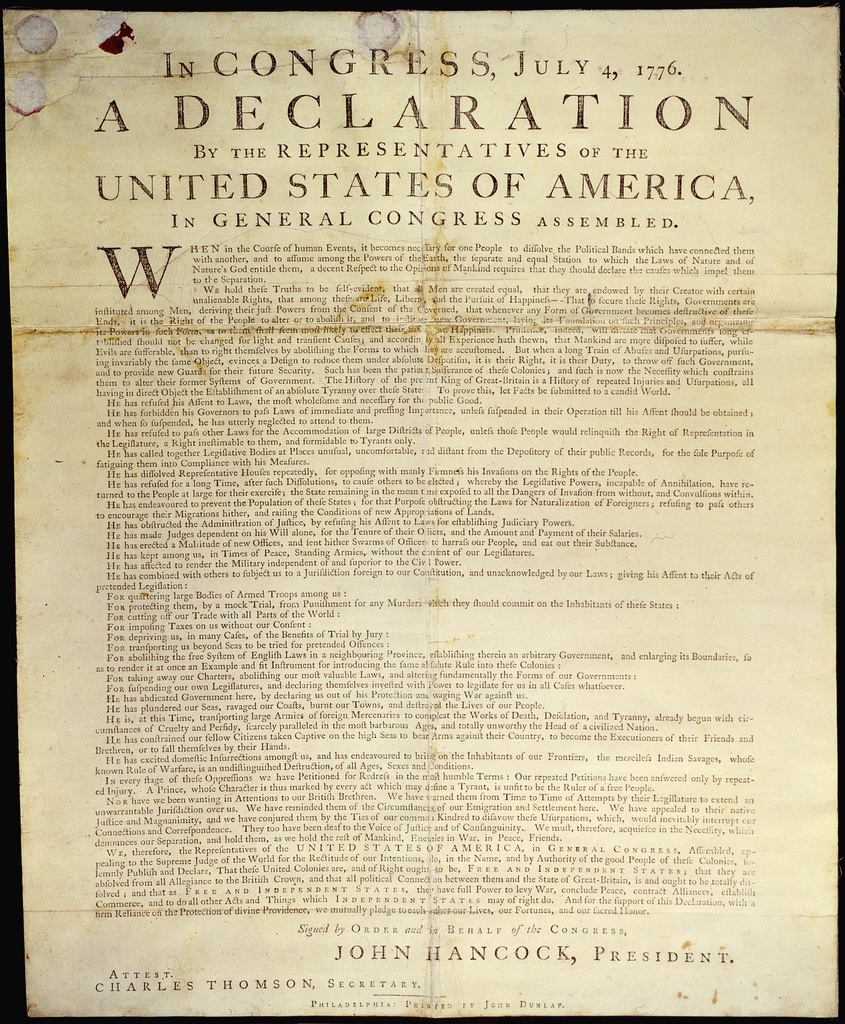
Homework 2 February 1: Read the Declaration of Independence and the passage that was deleted from it. Think about the questions below.
Were issues of racial equality implicated in the Declaration of Independence? If so, in what passages?
Why did Jefferson want to include the passage that was ultimately deleted?
Do you think the passage that replaced the deleted passage was effective?
168 powerful words condemning slavery that were removed from the Declaration of Independence.
When Thomas Jefferson included a passage attacking slavery in his draft of the Declaration of Independence it initiated the most intense debate among the delegates gathered at Philadelphia in the spring and early summer of 1776. Jefferson’s passage on slavery was the most important section removed from the final document. It was replaced with a more ambiguous passage about King George’s incitement of “domestic insurrections among us.” Decades later Jefferson blamed the removal of the passage on delegates from South Carolina and Georgia and Northern delegates who represented merchants who were at the time actively involved in the Trans-Atlantic slave trade.
The desire to exploit labor was a central feature of most colonizing societies in the Americas, especially those that relied on the exportation of valuable commodities like sugar, tobacco, rice and (much later) cotton. Cheap labor in large quantities was the critical factor that made these commodities profitable, and planters did not care who provided it – the indigenous population, white indentured servants and eventually African slaves – so long as they were there to be exploited.
Jefferson’s original passage on slavery appears below:
He has waged cruel war against human nature itself, violating its most sacred rights of life and liberty in the persons of a distant people who never offended him, captivating & carrying them into slavery in another hemisphere or to incur miserable death in their transportation thither. This piratical warfare, the opprobrium of infidel powers, is the warfare of the Christian King of Great Britain. Determined to keep open a market where Men should be bought & sold, he has prostituted his negative for suppressing every legislative attempt to prohibit or restrain this execrable commerce. And that this assemblage of horrors might want no fact of distinguished die, he is now exciting those very people to rise in arms among us, and to purchase that liberty of which he has deprived them, by murdering the people on whom he has obtruded them: thus paying off former crimes committed again the Liberties of one people, with crimes which he urges them to commit against the lives of another.
Question 1: Were issues of racial equality implicated in the Declaration of Independence? If so, in what passages?
‘We hold these truths to be self-evident, that all men are created equal, that they are endowed by their Creator with certain unalienable Rights, that among these are Life, Liberty and the pursuit of Happiness.”
Contradictions: Their world, ‘all men’ was a select group of white male landowners. They did not intend it to mean individual equality. Rather, what they declared was that American colonists, as a people, had the same rights to self-government as other nations.
America continued to be built upon systems of slavery and campaigns which robbed indigenous peoples of their lives and land. (White wives and daughters were property.)
Thomas Jefferson, the main architect of the Declaration of Independence. owned over 600 slaves, even went so far as to call slavery a ‘moral depravity’. Raped Sally Hemings Sally Hemmings, his slave and dead wife’s half-sister, so often that she had six enslaved children by him. At the time of the Declaration’s drafting, he owned 180 slaves, rising to 267 by 1822. He did not, as was often the practice, free his slaves upon his death.
The founding fathers phrased their own refusal to be “slaves” to Britain, government “[derives] their just powers from the consent of the governed” (The Declaration of Independence). Slaves are “governed” by their masters without their consent, which is another case of slaves being excluded from the rights that are supposed to be for all men.
The belief “that whenever any Form of Government becomes destructive of these ends, it is the Right of the People to alter or to abolish it, and to institute new Government, laying its foundation on such principles and organizing its powers” relates back to not intending this declaration to mean individual equality.
Question 2: Why did Jefferson want to include the passage that was ultimately deleted?
Thomas Jefferson drafted a passage in the Declaration, later struck out by Congress, that blamed the British monarchy for imposing slavery on unwilling American colonists, describing it as “the cruel war against human nature.”
Jefferson could not imagine how black and white peoples could ever coexist as free citizens in one republic. There was, he argued in Query XIV of his Notes, that there was already too much foul history dividing these peoples. And worse still, Jefferson hypothesized, in proto-racist terms, that the differences between the peoples would also doom this relationship. He thought that African Americans should be freed – but colonized elsewhere. (Stanford historian Jack Rakove.)
Question 3: Do you think the passage that replaced the deleted passage was effective?
In the removed section, Jefferson blamed Britain’s King George for his role in creating and perpetuating the transatlantic slave trade—which he describes, in so many words, as a crime against humanity. The passage was removal because of politics and money (glory and gold!). Both the South and the North made money from slavery.
The replacement passage talks of King George’s incitement of “domestic insurrections among us,” for stirring up warfare between the colonists and Native tribes.
The colonizers’ failure to directly address the slavery makes “all men created equal” = all white male property owners are equal.
An Act for the Gradual Abolition of Slavery, passed by the Fifth Pennsylvania General Assembly on 1 March 1780, prescribed an end for slavery in Pennsylvania. It was the first act abolishing slavery in the course of human history to be adopted by a democracy. The Act prohibited further importation of slaves into the state, required Pennsylvania slaveholders to annually register their slaves (with forfeiture for noncompliance, and manumission for the enslaved), and established that all children born in Pennsylvania were free persons regardless of the condition or race of their parents. Those enslaved in Pennsylvania before the 1780 law came into effect remained enslaved for life. Pennsylvania’s “gradual abolition”—rather than Massachusetts’s 1783 “instant abolition”—became a model for freeing slaves in other Northern states.
The Dutch and Swedish settlers in the Delaware Valley held Africans as slaves.
The 1780 Act prohibited further importation of slaves into Pennsylvania, but it also respected the property rights of Pennsylvania slaveholders by not freeing slaves already held in the state. It changed the legal status of future children born to enslaved Pennsylvania mothers from “slave” to “indentured servant”, but required those children to work for the mother’s master until age 28. To verify that no additional slaves were imported, the Act created a registry of all slaves in the state. Slaveholders who failed to register their slaves annually, or who did it improperly, lost their slaves to manumission. The 1780 Act specifically exempted members of the U.S. Congress and their personal slaves. Congress was then the only branch of the federal government under the Articles of Confederation, and met in Philadelphia.
The Act did not attack the rights of slave-owners, and those currently in slavery were not freed by the Act. In summary:
Sections 1 and 2 outline the purpose of the Act.
Section three states that all persons born in the state of Pennsylvania after the act was passed are no longer slaves or “lifelong servants of any kind.”
In Section 4, it goes on to say that even though the children born were not “slaves”, they are required to remain in the service of their owners as a type of indentured servant or apprentice until that child is 28 years old. This was an improvement since as indentured servants/apprentices, they had the same privileges, punishments and relief of servitude in case of mistreatment that they did not have hope of as slaves.
Section 5 requires all slave-owners to register their slaves annually, names ages, and etc. in order to enforce that the slaves would be freed at age 28 and to keep track of which ones had already been freed. If owners failed to register their slaves, they would have to free them by default.
Section 6 reinforces that as soon as the slaves reach 28, owners were required to give them a bill of sale and free them.
Section 7 gives slave children (the indentured) the same rights in a court of law as other indentured servants, though as slaves, they were still not allowed to testify against whites.
Section 8 promises reimbursement for slave-owners whose slaves were given the death sentence in court, based on the jury’s evaluation of the slave’s worth.
Section 9 covers the punishment for harboring or assisting runaway slaves.
Section 10 banned all future slavery and protected every freed man from ever being enslaved again, but excluded visitors to the state or anyone staying less than 6 months. Some people did take advantage of this section by carefully not staying longer than 6 months, leaving, and coming back.
Section 11 frees slaves who have run away and been missing for more than 5 years, while allowing owners to recover slaves during this time period.
Sections 12 and 13 make longer forms of indentured servitude illegal, regardless of laws in other states.
Section 14 repeals any older laws inconsistent with this new law.
Some slaveowners fought in court. Some just tried to work around it. Some enslavers moved out of state every six months to exploit the loophole made in Section 10. Some transported pregnant slaves over the state line to have their baby so that it was technically “born into slavery.” An amendment was made in 1788 to close this loophole, but it was overrulled as unconstitutional. Far from the 28 years planned, the last slaves in Pennsylvania weren’t freed until 1847, 67 years later.
William Penn received his charter in 1681
Quakers (including Penn) owned slaves.
Imported from the West Indies by way of port of Philadelphia.
PA slaves = house servants, farmhands, laborers on iron plantations, skilled craftsmen.
Pennsylvania “Black codes”
First written protest about slavery in England’s American colonies came from Germantown Friends in 1688.
slaves were not allowed to meet in groups of more than four;
they were not permitted to travel more than ten miles from their “master’s” residence without his permission
they could not marry Europeans
were not to be tried by juries
could not buy liquor.
The Philadelphia Yearly Meeting of Friends criticized the importation of slaves in 1696, objected to slave trading in 1754, and in 1775 determined to disown members who would not free their slaves.
1775 Pennsylvania Abolition Society was started was the first of its kind in the nation.
Throughout the 1700s, the Pennsylvania Assembly attempted to discourage the slave trade by taxing it repeatedly.
Benjamin Rush, Thomas Paine, and Richard Wells noted the hypocrisy of Americans “who condemned the tyranny of England’s colonial pollicies…while holding one-fifth of the colonial population in chains.”
Act for the Gradual Abolition of Slavery – passed by the Pennsylvania Assembly in 1780, first such legislative enactment in America, begins with an expression of gratitude for deliverance from the “tyranny of Great Britain” and for the opportunity to “extend a portion of that freedom to others.”
Every Negro and Mulatto child born within the State after the passing of the Act (1780) would be free upon reaching age twenty-eight. When released from slavery, they were to receive the same freedom dues and other privileges “such as tools of their trade,” as servants bound by indenture for four years. Slaves were to be registered and those not recorded were to be free. The bill passed by a vote of 34 to 21. The most consistent “opposition to abolition came from German Lutherans and Reformed representatives” from heavily German counties, at least seventy-five percent of whom voted against the bill. They feared that emancipation of slaves would affect their social status in Pennsylvania. Episcopal and Presbyterian representatives split on the issue.
The law freed few slaves immediately. Although Pennsylvanians could no longer legally import slaves; they could buy and sell those who had been registered.
Slavery declined after the passage of the act.
The Pennsylvania Abolition Society purchased a significant number of slaves and promptly set them free.
Between 1790 and 1800, the number of slaves dropped from 3,737 to 1,706 and by 1810 to 795. In 1840, there still were 64 slaves in the state, but by 1850 there were none.
Massachusetts Slavery
African slaves first arrived in Massachusetts in the 1630’s, and legalized the enslavement of Africans, Native Americans, and mixed-race people in The Body of Liberties, 1641. [Article 91, in William Henry Whitmore, The Colonial Laws of Massachusetts Reprinted from the Edition of 1660 With Supplements to 1672 Containing Also the Body of Liberties (Boston: Rockwell and Churchill, 1890), 53.]
“There shall be never be any bond slavery…amongst us, unless it be lawful captives taken in just wars, and such strangers as willingly sell themselves or are sold to us…”
Many laws were passed regulating movement and marriage among slaves, and Massachusetts residents actively participated in the slave trade. Historians estimate that between 1755 and 1764, the Massachusetts slave population was approximately 2.2 percent of the total population; the slave population was generally concentrated in the industrial and coastal towns.
In 1773, a group of slaves petitioned the General Court (legislature) to end slavery, and directly tied their search for liberty to the colonists’ struggles with Great Britain. The Massachusetts Constitution of 1780, in contrast, contained a declaration that “all men are born free and equal, and have . . . the right of enjoying and defending their lives and liberties.”
Because Massachusetts slaves were considered both as property and as persons before the law, slaves could institute and prosecute lawsuits in the courts against their master (the defendant) who would be obliged to demonstrate their lawful title to ownership of their slave. These cases were not decided on the basis of any “natural right” to freedom; instead, the courts required a specific point of law to decide in favor of a slave, such as a master’s broken promise to grant freedom, or the questionable slave status of the individual’s mother.
Virginia Statute for Religious Freedom
The act now commonly called the Virginia Statute for Religious Freedom began simply as Bill No. 82, “A Bill For establishing religious freedom.”
“A Bill for Establishing Religious Freedom,” June 18, 1779, in PTJ, 2:545-47. Transcription available at Founders Online.
After the American colonies declared independence from the United Kingdom, the Virginia General Assembly recognized that many of the laws that operated in King George’s loyal colony of Virginia would not work well in a newly independent state. Thus, in October 1776, the first General Assembly appointed a five-man Committee of Revisors to review the existing laws and redraft them for an independent Virginia.
Primary responsibility was assumed by the three lawyers on the committee, Thomas Jefferson, George Wythe, and Edmund Pendleton; but of the three, Jefferson assumed responsibility for the greater part of the drafting. In 1779, after Jefferson was elected Governor of Virginia, the committee’s catalog of 126 bills was presented to the General Assembly.
“Catalogue of Bills Prepared by the Committee of Revisors,” June 1-5, 1779, in PTJ, 2:329-35 (transcription available at Founders Online); Jefferson and Wythe to Benjamin Harrison, June 18, 1779, in PTJ, 2:301-04 (transcription available at Founders Online).
Many of the proposed laws were not adopted or even seriously considered. Jefferson, for example, bemoaned the lack of action on Bill No. 79, a “bill for the more general diffusion of knowledge,” which called for some state funded education at the primary, secondary, and college levels. Bill No. 82, though, was one of the notable successes in the process.
Bill No. 82 was guided through the legislative process by James Madison while Jefferson watched anxiously from Paris where he was serving as U.S. minister. The bill was also strongly supported by religious dissenters (primarily Presbyterians and Baptists) who had suffered under the established church in colonial Virginia and who desired religious freedom and a separation of church and state. Bill No. 82 was finally adopted in 1786.
Madison to Jefferson, January 22, 1786, in PTJ, 9:194-203. Transcription available at Founders Online. The Statute passed the Virginia Senate on January 16, 1786, a date now celebrated as Religious Freedom Day. The Statute was signed into law on January 19, 1786.
The original manuscript in Jefferson’s hand no longer exists. The text of the act as drafted by Jefferson (and approved by the Revisors) as well as the changes adopted by the General Assembly is provided below, with the General Assembly deletions shown in italics and the Assembly’s insertions shown within brackets):
Well aware that the opinions and belief of men depend not on their own will, but follow involuntarily the evidence proposed to their minds; that [Whereas] Almighty God hath created the mind free, and manifested his supreme will that free it shall remain by making it altogether insusceptible of restraint; that all attempts to influence it by temporal punishments, or burthens, or by civil incapacitations, tend only to beget habits of hypocrisy and meanness, and are a departure from the plan of the holy author of our religion, who being lord both of body and mind, yet chose not to propagate it by coercions on either, as was in his Almighty power to do, but to extend it by its influence on reason alone; that the impious presumption of legislators and rulers, civil as well as ecclesiastical, who, being themselves but fallible and uninspired men, have assumed dominion over the faith of others, setting up their own opinions and modes of thinking as the only true and infallible, and as such endeavoring to impose them on others, hath established and maintained false religions over the greatest part of the world and through all time: That to compel a man to furnish contributions of money for the propagation of opinions which he disbelieves and abhors, is sinful and tyrannical; that even the forcing him to support this or that teacher of his own religious persuasion, is depriving him of the comfortable liberty of giving his contributions to the particular pastor whose morals he would make his pattern, and whose powers he feels most persuasive to righteousness; and is withdrawing from the ministry those temporal[ry] rewards, which proceeding from an approbation of their personal conduct, are an additional incitement to earnest and unremitting labours for the instruction of mankind; that our civil rights have no dependance on our religious opinions, any more than on our opinions in physics or geometry; that therefore the proscribing any citizen as unworthy the public confidence by laying upon him an incapacity of being called to offices of trust and emolument, unless he profess or renounce this or that religious opinion, is depriving him injuriously of those privileges and advantages to which, in common with his fellow citizens, he has a natural right; that it tends also [only] to corrupt the principles of that very religion it is meant to encourage, by bribing, with a monopoly of worldly honours and emoluments, those who will externally profess and conform to it; that though indeed these are criminal who do not withstand such temptation, yet neither are those innocent who lay the bait in their way; that the opinions of men are not the object of civil government, nor under its jurisdiction; that to suffer the civil magistrate to intrude his powers into the field of opinion and to restrain the profession or propagation of principles on supposition of their ill tendency is a dangerous fallacy, which at once destroys all religious liberty, because he being of course judge of that tendency will make his opinions the rule of judgment, and approve or condemn the sentiments of others only as they shall square with or differ from his own; that it is time enough for the rightful purposes of civil government for its officers to interfere when principles break out into overt acts against peace and good order; and finally, that truth is great and will prevail if left to herself; that she is the proper and sufficient antagonist to error, and has nothing to fear from the conflict unless by human interposition disarmed of her natural weapons, free argument and debate; errors ceasing to be dangerous when it is permitted freely to contradict them.
We the General Assembly of Virginia do enact [Be it enacted by the General Assembly] that no man shall be compelled to frequent or support any religious worship, place, or ministry whatsoever, nor shall be enforced, restrained, molested, or burthened in his body or goods, nor shall otherwise suffer, on account of his religious opinions or belief; but that all men shall be free to profess, and by argument to maintain, their opinions in matters of religion, and that the same shall in no wise diminish, enlarge, or affect their civil capacities.
And though we well know that this Assembly, elected by the people for the ordinary purposes of legislation only, have no power to restrain the acts of succeeding Assemblies, constituted with powers equal to our own, and that therefore to declare this act [to be] irrevocable would be of no effect in law; yet we are free to declare, and do declare, that the rights hereby asserted are of the natural rights of mankind, and that if any act shall be hereafter passed to repeal the present or to narrow its operation, such act will be an infringement of natural right.
“A Bill for Establishing Religious Freedom,” June 18, 1779, in PTJ, 2:545-47. Transcription and editorial note available at Founders Online. The accompanying editorial note extensively explains some slight differences in the Jefferson version of the Statute and the text as adopted, and discusses the process of adoption and various printings of the text. See also Hening, The Statutes at Large, Vol. XII (Richmond: George Cochran, 1823), 84-86.
The movie Ground Hog Day is a comedy. Moral = you get off of the treadmill of life by stopping your selfishness to do something good to benefit the world.
Between 1492 and 1770 more Africans than Europeans entered the Americas (most to Brazil or the Caribbean). Over 10 million enslaved people – with about 260,000 by 1775 to the current United States.
Growth of Black Religion
Enslaved Africans a wide range of local religious beliefs and practices.
Slaves lived with high death rates, the separation of families and tribal groups, and the concerted effort of white owners to eradicate “heathen” (or non-Christian) customs.
Latin America, where Catholicism was most prevalent, slaves mixed African beliefs and practices with Catholic rituals and theology, resulting in the formation of entirely new religions such as vaudou in Haiti (later referred to as “voodoo”), Santeria in Cuba, and Candomblé in Brazil. But in North America, slaves came into contact with the growing number of Protestant evangelical preachers, many of whom actively sought the conversion of African Americans.
On Secret Religious Meetings
“A Negro preacher delivered sermons on the plantation. Services being held in the church used by whites after their services on Sunday. The preacher must always act as a peacemaker and mouthpiece for the master, so they were told to be subservient to their masters in order to enter the Kingdom of God. But the slaves held secret meetings and had praying grounds where they met a few at a time to pray for better things.” Harriet Gresham, born a slave in 1838 in South Carolina, as reported by her interviewer, ca. 1935
Southern slaves converted to evangelical religions such as the Methodist and Baptist faiths. Many clergy actively promoted the idea that all Christians were equal in the sight of god and encouraged worship in ways that many Africans found to be similar with enthusiastic singing, clapping, dancing, and even spirit-possession.
White owners insisted on slave attendance at white-controlled churches, since they were fearful that if slaves were allowed to worship independently they would ultimately plot rebellion against their owners. Many blacks saw these white churches, in which ministers promoted obedience to one’s master as the highest religious ideal, as a mockery of the “true” Christian message of equality and liberation as they knew it.
African Americans organized their own “invisible institution.” Through signals, passwords, and messages not discernible to whites, they called believers to “hush harbors” where they freely mixed African rhythms, singing, and beliefs with evangelical Christianity. It was here that the spirituals, with their double meanings of religious salvation and freedom from slavery, developed and flourished; and here, too, that black preachers, those who believed that God had called them to speak his Word, polished their “chanted sermons,” or rhythmic, intoned style of extemporaneous preaching.
BT’s formula for taking notes from the readings: look for SOA
The history of slavery is American history. White people (MEN) we’re required by law to keep an eye on black people.
Christianity was retrofited to benefit only white people.
We vs Them
GOLD — we get paid
GOD — inflict our religion on them
GLORY — for our supremacy over them
Bruce Taylor
“Blacks don’t know any better so we are going to teach them because we are / know better than them. Even if we baptize them we are still better than them.” This / religion / was used to justify conquest – gold for god’s glory.
The colonies did not have a separation of church and state.
Massachusetts was founded by Puritans to be a safe place for puritans. John Adams wrote the state’s constitution. Laws benefited the church.
Virginia was founded (and owned) by King George who was the political and religious head of England (and Virginia.) Laws benefited the church and England.
Hush Arbor or habor: During antebellum America, a hush harbor was a place where slaves would gather in secret to practice religious traditions.
Nat Turner: lead armed insurrection in Virginia in 1831 resulted in the deaths of scores of white men, women, and children, was a Baptist preacher sent by his owner to convert blacks.
peculiar institution: a euphemistic term that white southerners used for slavery. Its implicit message was that slavery in the U.S. South was “different”from the very harsh slave systems existing in other countries and that southern slavery had no impact on those living in northern states. Regardless of slave-holding status, economic status, and living situation, white southerners defended the “peculiar institution” of slavery because they believed that it was an economic and moral good. They believed that black people were made inferior, so slave labor suited them perfectly.
Atlantic Trade Routes By the late seventeenth century, an elaborate trade network linked the countries and colonies bordering the Atlantic Ocean. The most valuable commodities exchanged were enslaved people and projects of their labor.
Lord Dunmore – John Murray, 4th Earl of Dunmore, originally from Scotland, was the royal governor of the Colony of Virginia from 1771 to 1775.
Lord Dunmore’s Proclamation (designed to destroy Virginia and enrich the crown by freeing all enslaved people who fight on the side of England in the Revolutionary War.
In this proclamation, created on November 7, 1775, John Murray, Earl of Dunmore, the governor of Virginia, declares martial law, adjudged all revolutionaries as traitors to the crown, and emancipates all slaves and indentured servants willing to fight for the British.
The proclamation was practical and militaristic rather than humanitarianism. Dunmore wanted to add to his troops and scare the colonist so much that there would be a slave uprising that the colonists would abandon their revolution.
Black people don’t know whether to believe Dunmore or what to believe. The British were deeply implicated in the slave trade. Slavery at the time of the Revolution was still legal in the British colonies. The largest number of African peoples became free during the Revolution with this “escape” than become free until the Civil War. [Fath Ruffins on blacks’ reaction to Dunmore’s Proclamation]
The angered colonizers because freeing the enslaved, deprived them of their property rights. The Virginia Convention responded on December 14, 1775, with an unambiguous declaration that all fugitive slaves would be executed.
The 1779 Philipsburg Proclamation issued by British Army General Sir Henry Clinton on June 30, 1779, intended to encourage slaves to run away and enlist in the Royal Forces. During the course of the war, between 80,000 and 100,000 slaves escaped from the plantations. [Rough Crossings: Britain, the Slaves, and the American Revolution: Simon Schama, p. 19]
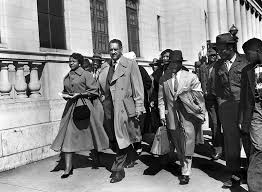
Autherine Lucy, Thurgood Marshall, and Arthur Shores
February 3, 1956 – Autherine Juanita Lucy enrolled as a graduate student in library science at the University of Alabama, becoming the first African American ever admitted to a white public school or university in the state. She attended her first class on Friday, February 3, 1956. On Monday, February 6, 1956, riots broke out on the campus which led to her expulsion under the guise of protecting her safety.
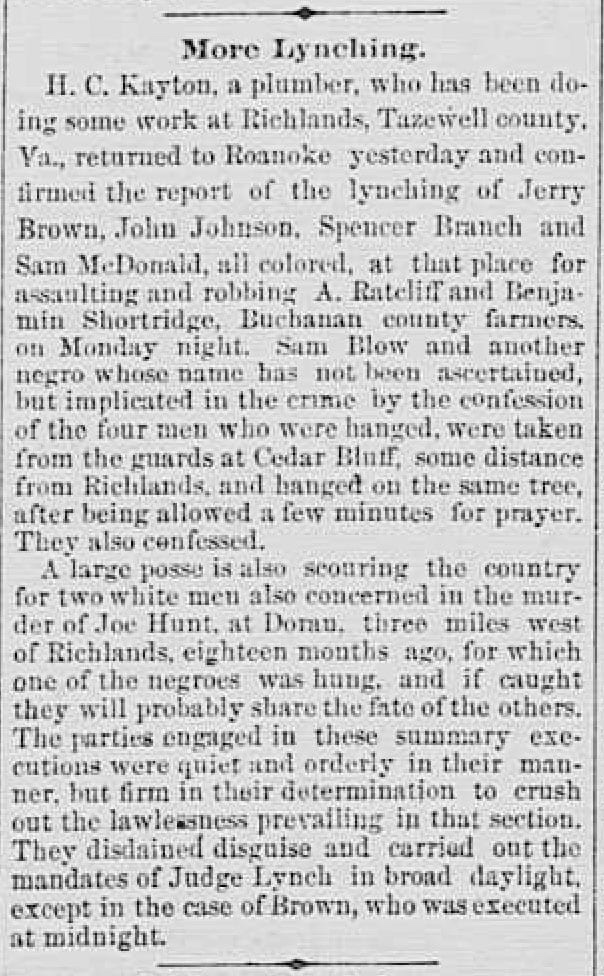
February 2nd, 1893 – Sam Blow, an African American man, was lynched in Richlands, Tazewell County, because another lynching victim, John Johnson, implicated him with the murder of Mr. Hunt, a white man. Five African American men were lynched in less than three days in Richlands in relation to the murder of two white merchants, including Sam Blow, Sam Ellerson, Spencer Branch, Jerry Brown, John Johnson, and possibly another unnamed victim.
I will make the rest of my life, the best of my life. I must be the star of my own life. To do that — to live my vision, to be the star of my own life — I need to learn how to hold fast. I say no to things that don’t feel right. I say yes to my vision for my own life. I play the long game. I bet on myself. I do my work and play my game. I trust what I know to be true, even when everyone else is telling me something different. I allow myself to deviate from the usual success formulas and the way things have always been done.Life doesn’t just happen to you, but you create it.
The phrenic nerve provides the primary motor supply to the diaphragm, the major respiratory muscle. It passes motor information to the diaphragm and receives sensory information from it.
When you’re creating a holiday tradition, consider the values you want to impart to your child.
If you take a role you don’t see benefitting your career, then no amount of money or prestige will make up for it. Sometimes it’s not about the money.
Rejection is normal. Overnight success takes ten years.
“When we confront challenges, we should ask whether we are exacerbating that challenge by trying to tackle it ourselves.”
File for a Fictitious Business Name also called DBA (Doing Business As). Run all your side hustle income through that. In the case of a business owned by an individual, a “fictitious business name” is any name that does not include the last name (surname) of the owner, or which implies additional owners (such as “Company”, “and Company”, “and Sons”, “Associates”, etc.). You register the name with the state.
Passion doesn’t pay the bills.
Write a hundred word story.
Write a six word story.
fabulist ~ a person who composes or relates fables. a storyteller. a liar, especially a person who invents elaborate, dishonest stories.
Spotlight effect ~ the phenomenon in which people tend to believe they are being noticed more than they really are.
Prevaricator ~ a person who speaks falsely; liar. a person who speaks so as to avoid the precise truth; quibbler; equivocator.
Lying, by Sam Harris, a small book with an absolutist approach: Don’t lie.
“therapeutic fibbing” ~ a helpful technique for Alzheimer’s patients because it allows them to avoid painful truths. You have to weigh compassion. The only compassionate thing to do is not to tell the truth.
anodyne ~ not likely to provoke dissent or offense; inoffensive, often deliberately so. a painkilling drug or medicine.
Imagine the impossible. Incorporate that tenet into all of your life. The only limitation to this assignment is your own imagination.
Simulator sickness — a subset of motion sickness that can be caused by virtual reality devices.
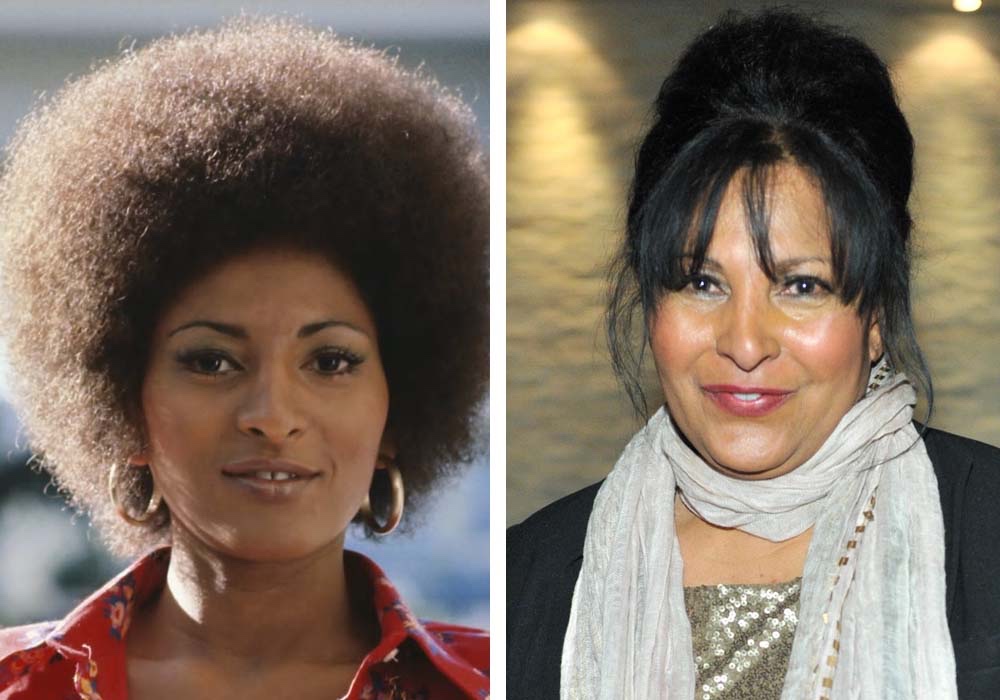
Pam Grier, then as Foxy Brown (right) and now. “If you wake up breathing, you are going to have a good day,” Grier enthused. “I have lived a great life, with great friends along my journey, I don’t worry about my age. I have so much to share.”
Pamela Suzette Grier (born May 26, 1949) is an American actress and first female action star. She achieved fame for her starring roles in a string of 1970s action, blaxploitation, and women in prison films for American International Pictures and New World Pictures. Grier came to prominence with her titluar roles in the filmsCoffy (1973) and Foxy Brown (1974); her other major films during this period included The Big Doll House (1971), Women in Cages (1971), The Big Bird Cage (1972), Black Mama, White Mama (1973), Scream Blacula Scream (1973), The Arena (1974), Sheba, Baby (1975), Bucktown(1975), and Friday Foster (1975). In the 1980s, Grier evolved into a character actress, playing a prostitute in Fort Apache, The Bronx (1981), a witch in Something Wicked This Way Comes (1983), and Steven Seagal’s detective partner in Above the Law(1988). She made guest appearances on numerous television series, like Miami Vice, Night Court, and The Fresh Prince of Bel-Air, and she had a recurring role in the TV series, Crime Story. She portrayed the titular character in Quentin Tarantino’s crime filmJackie Brown (1997), and also appeared in Escape from L.A.(1996), Jawbreaker (1999), Holy Smoke!, (1999), Bones (2001), Just Wright (2010), Larry Crowne (2011), and Poms (2019). On television, Grier portrayed Eleanor Winthrop in the Showtime comedy-drama series Linc’s (1998–2000), Kate “Kit” Porter on the Showtime drama series The L Word(2004–2009), and Constance Terry in the ABC sitcom Bless This Mess(2019–2020). She received praise for her work in the animated series Happily Ever After: Fairy Tales for Every Child (1999).
Courses required for college majors don’t always reflect the activities of the job. Talk to those actually doing the jobs you are considering. Investigate and don’t make assumptions.
When self-doubt arises or you make a misstep, focus on what you did right and identify how you can learn from your mistakes.
The concept of mindset is about how you perceive yourself and the world around you.
Elevator pitch ~ describe yourself, your business, gig or current project. Visualize yourself in an elevator ride with an executive at a company you’d like to work for. You quickly sell yourself before she exits the elevator to her floor. In politics, an elevator pitch = “talking points.” Practice it out loud in front of someone you trust who will give you honest feedback or record yourself.
“code-switching” ~ Noun LINGUISTIC the practice of alternating between two or more languages or varieties of language in conversation. It is a particularly insidious practice Black folk use to “fit in.” We abandon speaking AAVE (if that is how we normally speak, with our natural intonation and flow). Instead we adopt what we perceive or have been told is a “professionally-acceptable” manner of speaking. Code-switching involves adjusting one’s style of speech, appearance, behavior, and expression in ways that will optimize the comfort of others in exchange for fair treatment, quality service, and employment opportunities.
Black employees avoided stereotypes about black racial identity when they perceived that their organization either did not embrace diversity (also known as a color-blind ideology) or strongly embraced differences (also known as a multicultural ideology). In other words, a failure to acknowledge differences reduces the ability to recognize discrimination. Black employees might therefore seek to avoid stereotypes in color-blind organizations to avoid differential treatment. In contrast, companies that actively promote a diversity-friendly work environment can make the differences between groups more visible. Conforming to stereotypes in these multicultural environments may encourage the beliefthat black people have innate and fixed behaviors. Thus, in order to be seen as an individual, a black employee may code-switch
African-American Vernacular English (AAVE), also referred to as Black (Vernacular) English, Black English Vernacular, or occasionally Ebonics (a colloquial, controversial term), is the variety of English natively spoken, particularly in urban communities, by most working- and middle-class African Americans and some Black Canadians.
Consider inclusion separately from diversity.Research shows that valuing diversity is not enough to reduce discrimination toward minorities. In addition to focusing on diversity, organizations need to create inclusive environments for employees to feel comfortable bringing their authentic selves to work.
If you are designing, building, or participating in any system, think about feedback. How can you create space for it, harness it, and leverage it to build something great?
CRISPR (pronounced “crisper”) is a technology that allows researchers to edit DNA inside a living cell. DNA is made up of tiny, chemical subunits called nucleotides that, when strung together, hold the information. Some of those nucleotides are part of groups, called genes, that tell a cell how to make things it needs to function. The DNA in a living thing is called its genome.
When you finally became O.K. is when you forgave yourself.
Dixit – Latin “he/she/it said”.
Media rule of three. – When something happens once, it’s an incident. Twice, it’s a curiosity. Three times, it’s a trend.
To write a novel you need a story, compelling characters, a relatable and involving situation, physical and emotional complications, a theme, a genre or classification (underline this one!), and an overall vision.
If wanted to write a novel but don’t think you have the time, think of it this way: If you wrote a page a day, by the end of the year–or maybe even sooner–you will have finished your first draft. Sometimes even a single page can take a lot of time.
As you brainstorm ideas, ask yourself: “Why am I the only one who could write this particular story? What’s my unique connection to it?”
You don’t need a representative, you need a representable product.
logline ~ a brief summary of a television program, film, or book that states the central conflict of the story, often providing both a synopsis of the story’s plot, and an emotional “hook” to stimulate interest. Part of a logline (who, when, what, and why) A description of your main character (WHO). The inciting incident or event that triggers your story (WHEN). The action your character takes or the struggle or obstacles they face (WHAT). The goal (WHY). When inciting incident happens to main character, main character must take action in order to reach goal. If you have written a book where the setting (WHERE) is a different time period or a biography or a dystopian novel, the setting or description of the world can be prominent in your logline. A logline is typically just one or two clear, concise sentences. Some set a word limit of around 35 words. Example: “The Godfather”: “The aging patriarch of an organized crime dynasty transfers control of his clandestine empire to his reluctant son.”
If you want to make films, invite the people you like to work with, and give everyone a chance to play and grow.
The one thing that is absolutely within your control (and cannot be trained) is a good attitude. An attitude of gratitude and generosity is ideal, regardless of your role.
Always start a conversation, a relationship, a collaboration with giving something of value. Kind words? Good value! Good advice? Great value! Establish your attitude as giving or “we-centered,” not taking or “me-centered.”





 Relentless Robin