“I can do hard things. Doing hard things has intrinsic value, and they will make me a better person, even if I end up failing.”
Me
March Notes

“Sesquizygotic”~ the twins are semi-identical
Mental highlight reel. Prepare a ‘highlight’ reel of your success – family, education, athletics, coaching, work success. Include five items that made a difference in your life (13 second video)
Two Laws of Common Laws:
1) Do all you have agreed to do, and
2) Do not encroach on other persons or their property.
The deliberate killing of a person who has not harmed anyone is murder – even in war.
The majority does not vote for what is right, they vote for what they want.
Politics has always been the systematic organization of hatreds.
The overwhelming portion of murder in history has come from the hands of government.
While certain public policies would in the long run benefit everybody, other policies would benefit one group only at the expense of all other groups. The group that would benefit by such policies, having such a direct interest in them, will argue for them plausibly and persistently. It will hire the best buyable minds to devote their whole time to presenting its case. And it will finally either convince the general public that its case is sound, or so befuddle it that clear thinking on the subject becomes next to impossible. . . the whole of economics can be reduced to a single lesson, and that lesson can be reduced to a single sentence.The art of economics consists in looking not merely at the immediate but at the longer effects of any act or policy; it consists in tracing the consequences of that policy not merely for one group but for all groups.
Henry Hazlitt (1894-1993), was a libertarian philosopher, an economist, and a journalist. Hazlitt was a Libertarian and makes no apologies for his preference that government interfere in an economy only when the public good is incontrovertible.
Incontrovertible ~ not able to be denied or disputed.
“Real wealth, of course, consists in what is produced and consumed: the food we eat, the clothes we wear, the houses we live in.” ~ Henry Hazlitt
paradox of thrift ~ an economic theory that argues that personal savings can be detrimental to overall economic growth. It is based on a circular flow of the economy in which current spending drives future spending. It calls for a lowering of interest rates to boost spending levels during an economic recession.
Competition decreases your market share and shrinks your customer base, especially if demand for your products or services is limited from the start. A competitive market can also force you to lower your prices to stay competitive, decreasing your return on each item you produce and sell.
fallacy – LOGIC a failure in reasoning which renders an argument invalid. faulty reasoning; misleading or unsound argument. a mistaken belief, especially one based on unsound argument.
A fallacy is a kind of error in reasoning.
Lego is an abbreviation of two Danish words that together mean “play well.”
ephemerides ~ a table or data file giving the calculated positions of a celestial object at regular intervals throughout a period. a book or set of such tables or files.
Adversity + Support = Resilience
Decisions determine destiny. Learning is part habit and part choice.
Track what works.

Razorblade Tears

This month I checked the book club selection, Razorblade Tears by S. A. Cosby, out of our school library. This meant that I had to change the way I take notes. If I own the books I circle, underline and scribble notes in the margins.
The book centers around a seemingly random act of violence that sends two homophobic, ex-convict fathers, Buddy Lee Jenkins and Ike Randolph. When their sons (one black, one white and married to each other) are murdered, the middle-aged fathers grudgingly come together to avenge the murder of their sons despite both fathers being estranged from their sons and being almost as ashamed of the sons for being gay as the sons were ashamed of the fathers criminal records.
The two ex-cons had nothing in common but a murdering, violent criminal pasts and a love for their dead sons. A brash and unabashed redneck and a tatted up Black small businessman barely holding on to his restraint, Buddy Lee and Ike are virtual strangers who should have become family when their boys fell in love. But bigotry and bad judgment are hard habits to break. Though the book is full of gratuitous violence, blood and profanity, the complexity of the relationship between the fathers is as much a driving force of the storyline as the action; their tense relationship is defined by mistrust and suspicion yet evolves into acceptance and ‘family.’
Though violence is a major component of the narrative in Razorblade Tears I enjoyed the storyline so much that I read the book in to – long – sittings and thought about the characters when I did not have time to read.
Epicurean– fond of or adapted to luxury or indulgence in sensual pleasures; having luxurious tastes or habits, especially in eating and drinking. fit for an epicure: epicurean delicacies. (initial capital letter) of, relating to, or characteristic of Epicurus or Epicureanism.

Tam-o’-shanter – a woolen cap of Scottish origin with a tight headband, wide flat circular crown, and usually a pompon in the center
If you stay prepared, you didn’t have to get prepared. – Andy (before he broke into Isaiah and Derek’s home.
This is who I am. I can’t change. I don’t want to, really. But for once I’m gonna put this devil inside me to good use.” – Buddy Lee at his son’s grave side after he put Andy’s corpse through the wood chipper and buried the chips in a manure pile in Ike’s warehouse.
Human beings were wired to get used to just about anything. That didn’t make you hard. It makes you indoctrinated.
Hirsuteness– Covered with hair; hairy. Covered with stiff or coarse hairs.
…an honest day’s work. Of hours spent beautifying someone’s yard who wouldn’t spit on you if you were on fire but had to pay you because they wouldn’t or couldn’t be bothered to put down their own mulch or fertilize their own flower gardens.
Men might walk on two legs but they were the most vicious animals of all. Especially when they thought they had a numbers advantage.
Time makes loyalty thin. People shed it like snakeskin.
I’ve learned to always be ready to be disappointed by white people. Doesn’t always happen, but when it does, it don’t shock me anymore. – Ike to Buddy Lee
…you remember when they used to play The Ten Commandants on television every Easter? And there’s this part where the boy tells his granddaddy to look at the Nubians? My granddaddy on my mamma’s side would always make this joke about them not being Nubians, they just, you know, what he said. And I used to laugh at that joke because it it was my granddaddy saying it. I never thought , I never had to think how someone like you would feel about that joke. Then when I got older I stopped thinking about it, because if that joke was fucked up, then what did that say about my granddaddy? What did it say about me that I laughed at it? – Buddy Lee said to Ike
Folks like to talk about revenge like it’s a righteous thing but it is just hate in a nicer suit. – Ike to Tangerine

Civil Rights Class Week 6
I forgot to post this before spring break.
Southern novelist William Faulkner’s famous line saying “The past is never dead. It’s not even past,” is usually interpreted as a reflection on how the evils of our history continue to shape the present. But Faulkner also argued, equally accurately, that the past is “not even past” because what happens in the present changes the way we remember the past.
Heather Cox Richardson
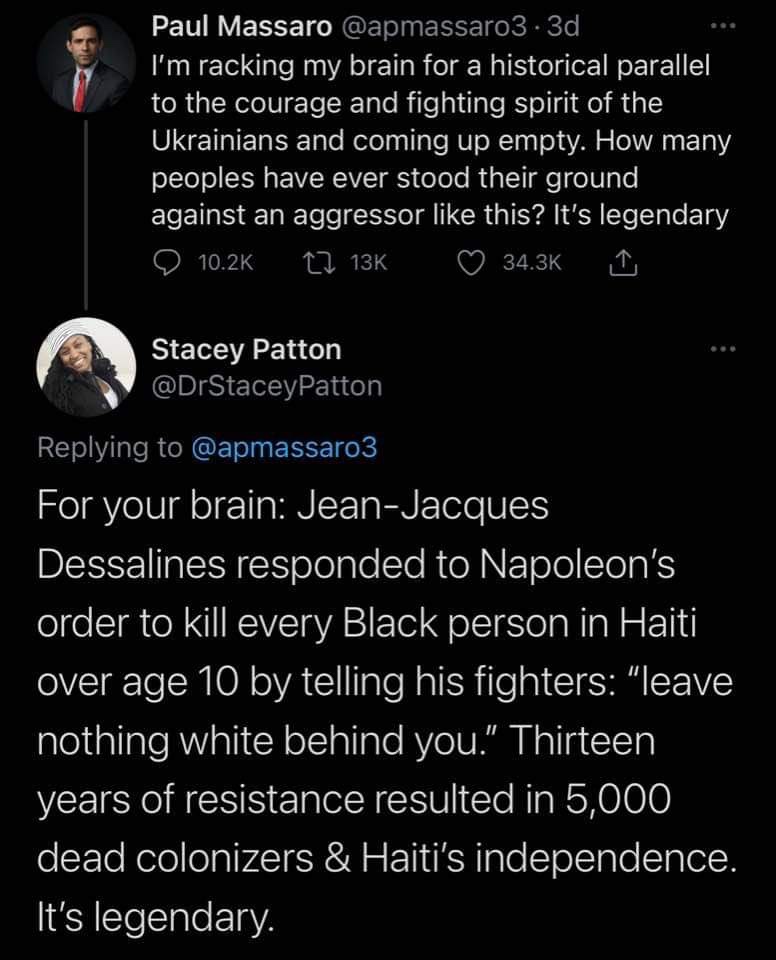

Wentworth Cheswell (11 April 1746 – 8 March 1817) [His father, Hopestill Cheswell, was born free to a white mother and Richard Cheswell, an indentured black laborer in Exeter, New Hampshire, who was the first Cheswell recorded in New England.] Wentworth Cheswell was an American assessor, auditor, Justice of the Peace, teacher and Revolutionary War veteran in Newmarket, New Hampshire. Elected as town constable in 1768, he was elected to other positions, serving in local government every year but one until his death. (He went to Governor’s Academy!) Cheswell is considered by George Mason University to be the first African American elected to public office in the history of the United States. [http://hnn.us/article/51808http://hnn.us/article/51808]
Wentworth Cheswell is honored as a Revolutionary hero rather closely modeled on the figure of Paul Revere. As the town messenger on the Committee of Safety during the Revolution, he too, had made an all-night ride back from Boston to warn his community of the impending British invasion.
In April 1776, he signed a document in which he pledged, “at the risk of . . . live and fortune,” to take up arms to resist the British, and in September 1777, he enlisted in a company of Light Horse Volunteers commanded by Colonel John Langdon (Langdon later became one of the 55 Founding Fathers who drafted the U. S. Constitution, then a framer of the Bill of Rights, and later the New Hampshire governor). Langdon’s company made a 250-mile march to Saratoga, New York, to join with the Continental Army under General Horatio Gates to defeat British General Burgoyne at the Battle of Saratoga – the first major American victory in the Revolution. [Rachel Grace Toussaint, “Legacy of Newmarket founding father revealed”, seacoastonline.com, 22 December 2002, hosted at Newmarket, New Hampshire Historical Society]
Housewright~ a builder of wooden houses : a house carpenter.
William Hamilton (1773 – December 9, 1836) was a prominent African-American orator and civil rights activist, based in New York City. He was born to a free black woman and was reputed to be a natural son of Alexander Hamilton, the Founding Father. William Hamilton is best known as a leader in the first wave of American abolitionism. [Leslie M. Alexander, African or American?: Black Identity and Political Activism in New York City, 1784-1861 (2013), p. 253 and passim.]
Natural child ~ a child born out of lawful wedlock : an illegitimate child; a bastard – and are distinguished from legitimate children.
Sic passim ~ so throughout —used of a word or idea to be found throughout a book or a writer’s work.
Passim ~ : in one place and another —used in citations of cases, articles, or books to indicate that something (as a word, phrase, or idea) is found at many places in the work cited; here, there, and everywhere. every which way. everywhere in. all through.
Juan Garrido was the first documented African American. Much of what we know about Garrido comes from his probanza de merito, or “proof of merit,” which states that while he was from West Africa born and raised, exploring is where he spent most of his days. Born around 1487, Garrido moved to Portugal before eventually landing in Spain, converting to Christianity and changing his name to what translates as “Johnny Handsome”. Historian Ricardo Alegría believes Garrido was the son of an African king who sent his son to Portugal as an emissary. In any case, in 1503, at 15 years old, Garrido joined explorer Ponce de Leon’s expedition to New World, landing on Hispaniola’s island. From there, Garrido rode around with Ponce de Leon as the Spanish explorer enslaved and killed Taino around the Caribbean.
Hiram Rhodes Revels (September 27, 1827 – January 16, 1901) was first African American elected to US Congress (1870).
Homework 1:
John C. Calhoun on the Error of “All Men are Created Equal” (1848) in this speech, John C. Calhoun, South Carolina’s leading proponent of slavery, asserted that that the Declaration of Independence was in error when it stated that “all men are created equal.” Echoing classical republican themes, he argued that liberty was a prize that should be granted only to those sufficiently moral and worthy. Unlike early republicans, Calhoun found these qualities not in rare selfless individuals or even independent propertied classes, but in the white race itself. Calhoun went on to say that liberty is something to be earned. As you read his speech, consider the logic and proof he marshaled to disprove the common claim that “all men are born free and equal.” How did his racial republicanism reflect larger changes in the national debate over slave and free labor?
Reading notes:
Calhoun — the man who started the civil war — asserted that the Declaration of Independence was in error when it stated that “all men are created equal.” He argued that liberty was a prize that should be granted only to those sufficiently moral and worthy. He said liberty is something to be earned.

It is the most false and dangerous of all political errors that “all men are born free and equal.”
- Infants not men are born.
- Infants are incapable freedom and savage and civilized, until the development of their intellect and physical capacity enables them to take care of themselves.
- “all men are created equal” is not true because it was inserted in our Declaration of Independence without any necessity.
- The worst form of government is better than anarchy; and that individual liberty, or freedom, must be subordinate to whatever power may be necessary to protect society against anarchy within or destruction from without;
- Instead of all men having the same right to liberty and equality, they are high prizes to be won, and are in their most perfect state, not only the highest reward that can be bestowed on our race, but the most difficult to be won-and when won, the most difficult to be preserved.
George Fitzhugh, “The Universal Law of Slavery” (1850) After 1830, increasingly radical arguments emerged both for and against slavery. In the South, the lawyer and author George Fitzhugh became perhaps the most radical defender of slavery and the hierarchical social order of which it was the lynchpin. He disdained America’s claim to be a “free society” and welcomed the eclipse of that ideal in favor of the “community” of masters and slaves, united in their mutual dependence. As you read his argument, consider the role of the rising theories of scientific racism in his conclusions. What does he say about the “free labor” society that was being celebrated by the more urban and industrial North?
Reading notes:
After 1830, increasingly radical arguments emerged both for and against slavery.
Fitzhugh:
- most radical defender of slavery and the hierarchical social order of which it was the lynchpin.
- disdained America’s claim to be a “free society”
- welcomed the eclipse of that ideal in favor of the “community” of masters and slaves, united in their mutual dependence
- Believed in theories of scientific racism
- Negro is a grown up child, and must be governed as a child with master a parent or guardian.
- Negro is improvident
- Negros would become an insufferable burden to society unless he is a slave
- negro race is inferior to the white raceradual but certain extermination would be their fate if freed
- Blacks would become idolatrous, savage and cannibal, or be devoured by savages and cannibals if returned to Aftics or taken to West Indies.
- Freed in the North Blacks would freeze or starve.
- Negroes are better off morally as slaves
- “The negro slaves of the South are the happiest, and, in some sense, the freest people in the world. The children and the aged and infirm work not at all, and yet have all the comforts and necessaries of life provided for them. They enjoy liberty, because they are oppressed neither by care nor labor. The women do little hard work, and are protected from the despotism of their husbands by their masters. The negro men and stout boys work, on the average, in good weather, not more than nine hours a day. The balance of their time is spent in perfect abandon.”
- The master labors for the slave, they exchange industrial value.
Improvement ~ not having or showing foresight; spendthrift or thoughtless; : not provident; not foreseeing and providing for the future.
Idolatrous ~ worshiping idols; treating someone or something as an idol.
Despotism ~ the exercise of absolute power, especially in a cruel and oppressive way; a country or political system where the ruler holds absolute power.
Homework 2: Read the founding document of the American Anti-Slavery Society. Declaration of Sentiments of the American Anti-Slavery Society, William Lloyd Garrison (1833)
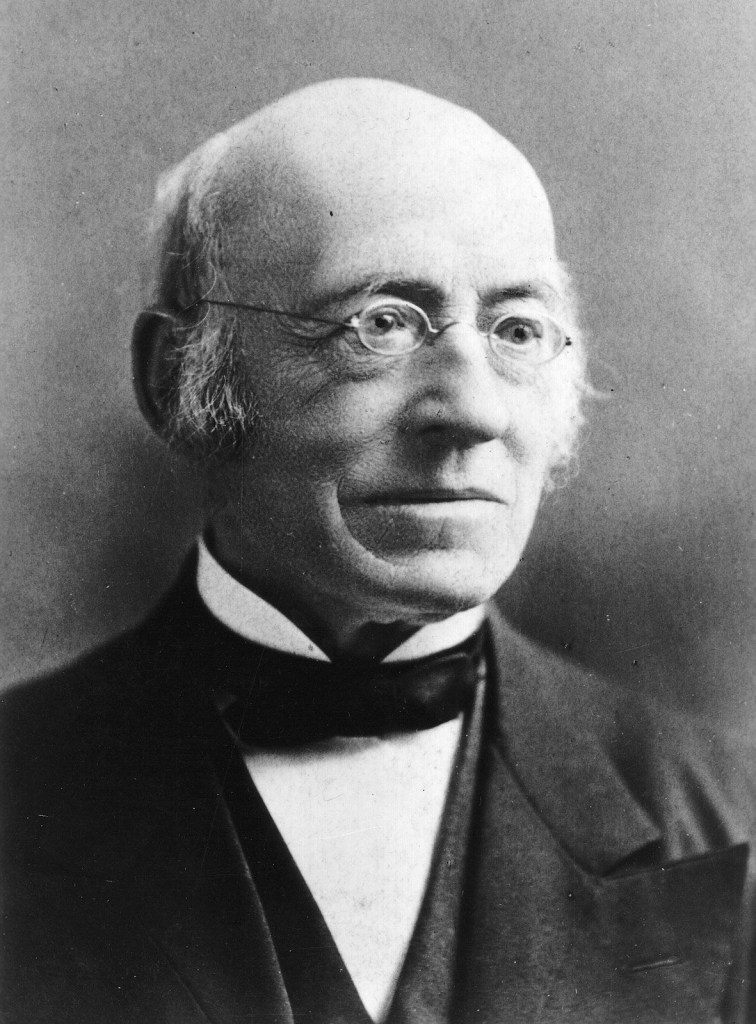
Library of Congress, Washington, D.C.
In 1833, the same year that Lydia Maria Child published her appeal, a group of abolitionists gathered together to found the American Anti-Slavery Society. A number of the representatives had been involved in the creation of the New England Anti-Slavery Society in 1832 and the New York society that followed, but they believed that there should be a national organization. Prominent among them was William Lloyd Garrison (1805–1879). Garrison gave his first public address against slavery in 1829, and soon thereafter, in 1831, began publishing the Boston Liberator. Over the next three decades he vigorously fought slavery with words even as he opposed violence to free the slaves. Besides his public speeches and Liberator editorials, Garrison helped to draft the New England society’s constitution as well as the Declaration of Sentiments of the American Anti-Slavery Society. He also served as president of the latter society from 1843 to 1865.
Reading notes:
Declaration of Sentiments of the American Anti-Slavery Society
William Lloyd Garrison (11805–1879) helped start National Anti-Slavery Society. In 1831 he began publishing the Boston Liberator. Over the next three decades he vigorously fought slavery with words even as he opposed violence to free the slaves.
Temple of Freedom ‘that all men are created equal; that they are endowed by their Creator with certain inalienable rights; that among these are life, LIBERTY, and the pursuit of happiness.’
‘Every man has a right to his own body—to the products of his own labor—to the protection of law—and to the common advantages of society. It is piracy to buy or steal a native African, and subject him to servitude. Surely, the sin is as great to enslave an American as an African. Therefore we believe and affirm—that there is no difference, in principle, between the African slave trade and American slavery: That every American citizen, who detains a human being in involuntary bondage as his property, is, according to Scripture, (Ex. xxi. 16,) a man-stealer.’
…’freeing the slave is not depriving them of property, but restoring it to its rightful owner; it is not wronging the master, but righting the slave—restoring him to himself: Because immediate and general emancipation would only destroy nominal, not real property; it would not amputate a limb or break a bone of the slaves, but by infusing motives into their breasts, would make them doubly valuable to the masters as free laborers; and Because, if compensation is to be given at all, it should be given to the outraged and guiltless slaves, and not to those who have plundered and abused them.’
‘We fully and unanimously recognise the sovereignty of each State, to legislate exclusively on the subject of the slavery which is tolerated within its limits; we concede that Congress, under the present national compact, has no right to interfere with any of the slave States, in relation to this momentous subject: But we maintain that Congress has a right, and is solemnly bound, to suppress the domestic slave trade between the several States, and to abolish slavery in those portions of our territory which the Constitution has placed under its exclusive jurisdiction.’
* * * Done at Philadelphia, December 6th, A.D.1833 [From Selections from the Writings and Speeches of William Lloyd Garrison. Orig. publ. in 1852 by R. F. Wallcut. (New York: Negro Universities Press, 1968), pp. 66–71.]
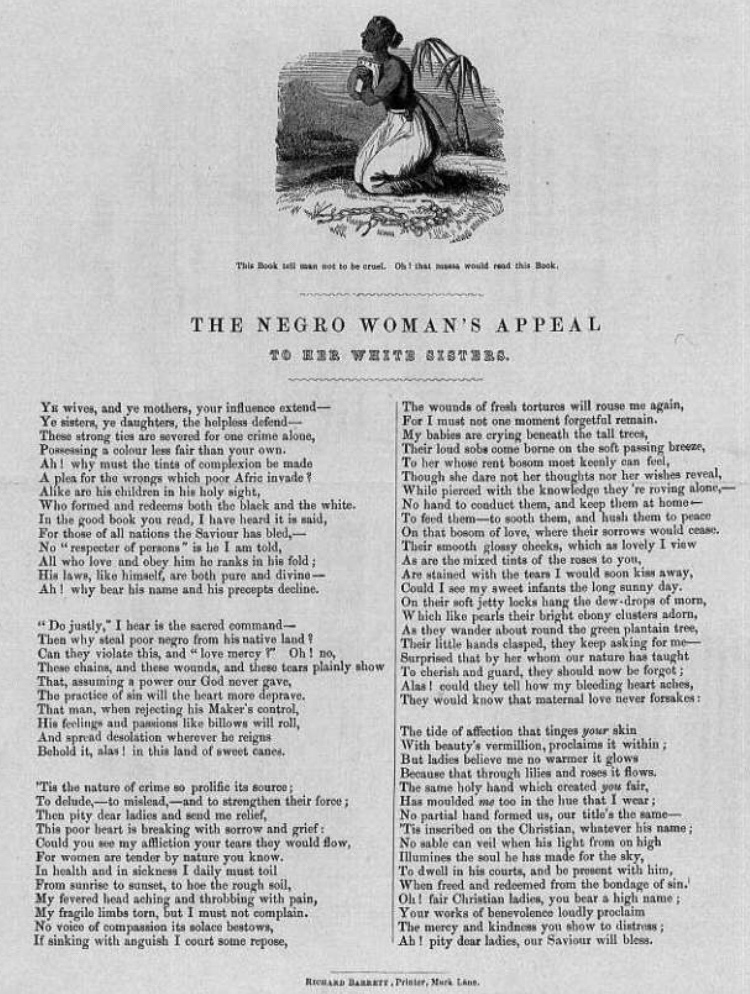
Reading notes:
https://www.loc.gov/exhibits/african/afam005.html#obj11
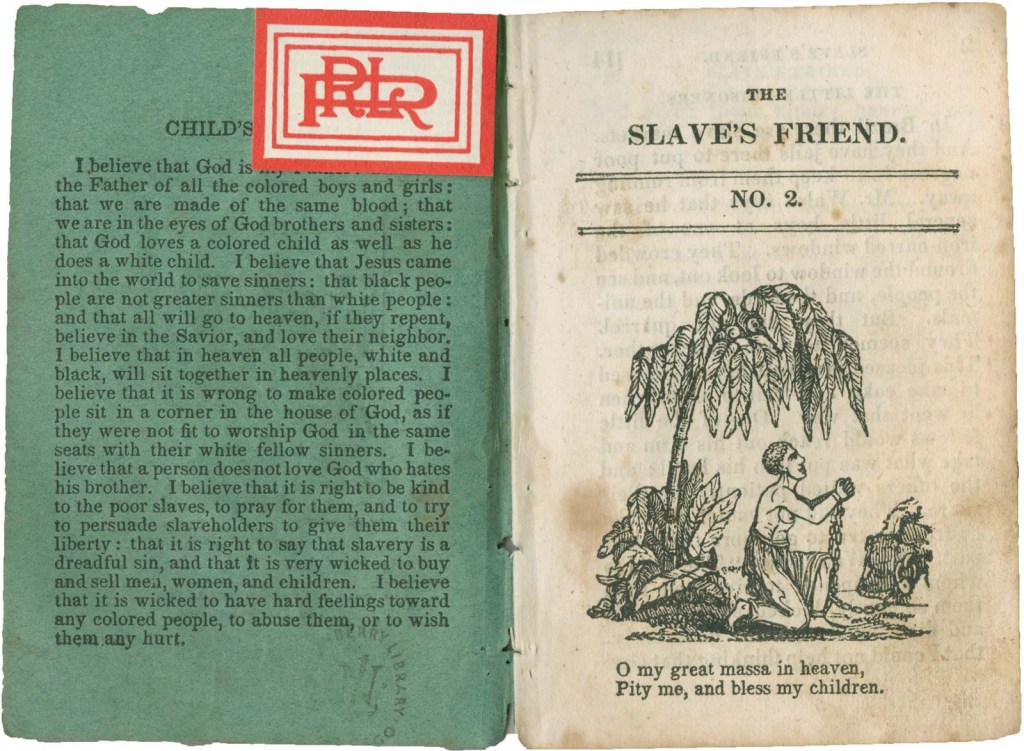
William Lloyd Garrison (1805–1879). Garrison gave his first public address against slavery in 1829, and soon thereafter, in 1831, began publishing the Boston Liberator.
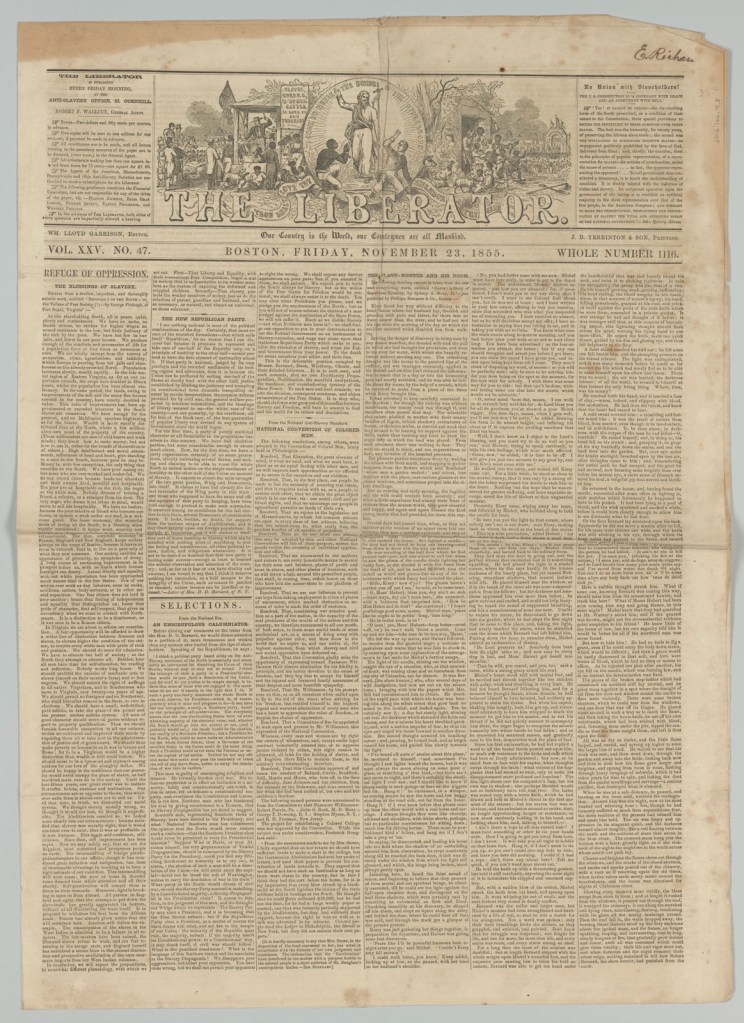
Smithsonian National Museum of African American History and Culture, Washington, D.C.; gift from the Liljenquist Family Collection (object no. 2016.166.41.8)
57 years after declaration of proclamation
“Their principles led them to wage war against their oppressors, and to spill human blood like water, in order to be free.” However the Anti-Slavery Society must not use violence but only the “power of love.”
“…at the present time at least one sixth part of our countrymen—are recognized by law, and treated by their fellow-beings, as marketable commodities, as goods and chattels, as brute beasts; . . . For the crime of having a dark complexion, they suffer the pangs of hunger, the infliction of stripes, the ignominy of brutal servitude. They are kept in heathenish darkness by laws expressly enacted to make their instruction a criminal offence.”
“The right to enjoy liberty is inalienable. To invade it is to usurp the prerogative of Jehovah. Every man has a right to his own body—to the products of his own labor—to the protection of law—and to the common advantages of society. It is piracy to buy or steal a native African, and subject him to servitude. Surely, the sin is as great to enslave an American as an African. Therefore we believe and affirm—that there is no difference, in principle, between the African slave trade and American slavery:”
Fight for” immediate and total abolition of slavery.”
The slaveholders should not be paid to free them because slavery is a crime and free a slave returns the slave to their proper owner — themself.
“Because, if compensation is to be given at all, it should be given to the outraged and guiltless slaves, and not to those who have plundered and abused them.”
Black people need to be paid for their labor.
“…we maintain that Congress has a right, and is solemnly bound, to suppress the domestic slave trade between the several States, and to abolish slavery in those portions of our territory which the Constitution has placed under its exclusive jurisdiction. We also maintain that there are, at the present time, the highest obligations resting upon the people of the free States to remove slavery by moral and political action, as prescribed in the Constitution of the United States.”
Southern States…”authorize the slave owner to vote for three-fifths of his slaves as property, and thus enable him to perpetuate his oppression; they support a standing army at the South for its protection; and they seize the slave, who has escaped into their territories, and send him back to be tortured by an enraged master or a brutal driver. This relation to slavery is criminal, and full of danger: IT MUST BE BROKEN UP.”
They plan to;
- Organize Anti-Slavery Societies, if possible, in every city, town and village in our land.
- Send forth agents to lift up the voice of remonstrance, of warning, of entreaty, and of rebuke.
- Circulate, unsparingly and extensively, antislavery tracts and periodicals.
- Enlist the pulpit and the press in the cause of the suffering and the dumb.
- Aim at a purification of the churches from all participation in the guilt of slavery.
- Encourage the labor of freemen rather than that of slaves, by giving a preference to their productions
- Spare no exertions nor means to bring the whole nation to speedy repentance
[From Selections from the Writings and Speeches of William Lloyd Garrison. Orig. publ. in 1852 by R. F. Wallcut. (New York: Negro Universities Press, 1968), pp. 66–71.]
Listen to Martin Luther King Jr.’s ‘I Have a Dream’ speech in its entirety.
Class notes: Feb 28, 2022 –
Bruce Taylor read parts of this MLk speech and explained how it parallels the Declaration of Sentiments of the American Anti-Slavery Society by William Lloyd Garrison: “…In a sense we have come to our Nation’s Capital to cash a check. When the architects of our great republic wrote the magnificent words of the Constitution and the Declaration of Independence, they were signing a promissory note to which every Anerican was to fall heir. This note was a promise that all men, yes, black men as well as white men, would be guaranteed to the inalienable rights of life liberty and the pursuit of happiness. It is obvious today that America has defaulted on this promissory note insofar as her citizens of color are concerned. Instead of honoring this sacred obligation, America has given its colored people a bad check, a check that has come back marked ‘insufficient funds.’ But we refuse to believe that the bank of justice is bankrupt. We refuse to believe that there are insufficient funds in the great vaults of opportunity of this nation. So we have come to cash this check, a check that will give us upon demand the riches of freedom and security of justice.”- From Martin Luther King, Jr.’s ‘I Have a Dream’ speech

American Colonization Society = back to Africa (Republic of Liberia)
American Anti-Slavery Society = equal rights for blacks
[Liberia began in the early 19th century as a project of the American Colonization Society (ACS), which believed black people would face better chances for freedom and prosperity in Africa than in the United States. Between 1822 and the outbreak of the American Civil War in 1861, more than 15,000 freed and free-born black people who faced social and legal oppression in the U.S., along with 3,198 Afro-Caribbeans, relocated to Liberia. Gradually developing an “Americo-Liberian” identity, the settlers carried their culture and tradition with them; the Liberian constitution and flag were modeled after those of the U.S., while its capital was named after ACS supporter and U.S. President James Monroe. Liberia declared independence on July 26, 1847, which the U.S. did not recognize until February 5, 1862. On January 3, 1848, Joseph Jenkins Roberts, a wealthy, free-born African American from the U.S. state of Virginia who settled in Liberia, was elected Liberia’s first president after the people proclaimed independence.]
1/6 of the population in the us in 1830 were slaves.
American Anti-Slavery Society became national putting all the local and state societies together. They met in the same place as the congressional congress when they signed the declaration of independence
Abolitionists were seen as crazy fringe people on the margins – extremists who worked from the underground.
Garrison’s paper was thought to be in on Nat Turner’s revolution – either directly or indirectly. The south put a price on his head.
“Behind numbers is strength.” – Bruce Taylor
LIBERTY – and its creation was incomplete because it did not include the slaves. The fore fathers “missed” freeing the slaves with the revolution. They fought a war to gain independence just for white men.
Garrison was a pacifist and preached against the use of violence to end slavery. He wanted an end to slavery immediately. He was waging a spiritual quest to end slavery. He believed that slavery was evil and should be ended. Once slavery is ended, the slaves should be given equal rights to white people. He said states have rights to decide about slavery in their own states but congress has the right stop sales of slaves between states and to not allow slavery in the new territories.
Not all abolitionists agreed. Some wanted to end slavery right away. Others wanted to do it slowly. Some were against violence to end slavery. Others wanted to use “god” and peaceful means.
Carnal weapons – war materials, weapons, and munitions; weapons of the body
Spiritual warfare ~ the Christian concept of fighting against the work of evil forces.
“The founding fathers grievances were not as great as the suffering of the slaves,” said Garrison. “If you feel empathy for the founding fathers, you should feel even more empathy for the enslaves.”
“…brutalized his mind, by denying him the means of intellectual, social, and moral improvement.”
1808 the slave trade ended, but American slave trade continued.
Abrogate – abolish; repeal or do away with (a law, right, or formal agreement); evade (a responsibility or duty)
Delusive – giving a false or misleading impression; misleading
Territories – an organized division of a country that is not yet admitted to the full rights of a state.
Homework 3: Fugitive Slave Law of 1850 The Fugitive Slave Act was one of four components of the Compromise of 1850. Both northerners and southerners were convinced that economic growth and prosperity lay in westward expansion. A “free soil” movement gained strength in the North that for some Americans meant a commitment to preventing the moral blight of slavery from spreading into new territories, but for many more Americans meant an effort to ensure that white labor would not have to compete with (or live beside) African-American slave labor. The South feared that its cash crop economy would collapse without new lands and that it would lose more control of the federal government with the enfranchisement of each new free state. The Fugitive Slave Act proved bitterly controversial. As you read the text, consider what powers the law gave the federal government and its agents over the citizens of any state harboring a fugitive. How could states’ rights advocates from the South have supported such an act? What actions of the slaves themselves made necessary such a desperate and novel piece of legislation?

Reading notes:
Fugitive Slave Acts, in U.S. history, statutes passed by Congress in 1793 and 1850 (and repealed in 1864) that provided for the seizure and return of runaway slaves who escaped from one state into another or into a federal territory. The Act was one of the most controversial elements of the 1850 compromise and heightened Northern fears of a slave power conspiracy. It required that all escaped slaves, upon capture, be returned to the slaver and that officials and citizens of free states had to cooperate. The Act contributed to the growing polarization of the country over the issue of slavery, and was one of the factors that led to the Civil War. [Other important factors were partisan politics, abolitionism, nullification versus secession, Southern and Northern nationalism, expansionism, economics, and modernization in the Antebellum period.]
By 1843, several hundred enslaved people a year escaped to the North successfully, making slavery an unstable institution in the border states. The earlier Fugitive Slave Act of 1793 was a Federal law that was written with the intent to enforce Article 4, Section 2, Clause 3 of the United States Constitution, which required the return of escaped enslaved people. It sought to force the authorities in free states to return fugitives of enslavement to their masters.Many Northern states wanted to disregard the Fugitive Slave Act. Some jurisdictions passed personal liberty laws, mandating a jury trial before alleged fugitive slaves could be moved; others forbade the use of local jails or the assistance of state officials in the arrest or return of alleged fugitive slaves. In some cases, juries refused to convict individuals who had been indicted under the Federal law. [Thomas D. Morris (1974). Free Men All: The Personal Liberty Laws of the North, 1780–1861. The Lawbook Exchange. p. 49. ISBN 9781584771074.]
Senator James M. Mason of Virginia drafted the Fugitive Slave Act of 1850, which penalized officials who did not arrest someone allegedly escaping from slavery, and made them liable to a fine of $1,000 (equivalent to $31,110 in 2020). Law enforcement officials everywhere were required to arrest people suspected of escaping enslavement on as little as a claimant’s sworn testimony of ownership. Habeas corpus was declared irrelevant, and the Commissioner before whom the fugitive from slavery was brought for a hearing—no jury was permitted, and the alleged refugee from enslavement could not testify—was compensated $10 if he found that the individual was proven a fugitive, and only $5 if he determined the proof to be insufficient. In addition, any person aiding a fugitive by providing food or shelter was subject to six months’ imprisonment and a $1,000 fine. Officers who captured a fugitive from slavery were entitled to a bonus or promotion for their work.
Enslavers needed only to supply an affidavit to a Federal marshal to capture a fugitive from slavery. Since a suspected enslaved person was not eligible for a trial, the law resulted in the kidnapping and conscription of free Blacks into slavery, as suspected fugitive slaves had no rights in court and could not defend themselves against accusations.
The Act adversely affected the prospects of escape from slavery, particularly in states close to the North. One study finds that while prices placed on enslaved people rose across the South in the years after 1850 it appears that “the 1850 Fugitive Slave Act increased prices in border states by 15% to 30% more than in states further south”, illustrating how the Act altered the chance of successful escape.
Sections 1-4 include the rules and regulations for catching the fugitives as said in Section 1-3, these sections “established the rules by which federal commissioners were appointed.” This explained who would be chosen to catch the fugitives. In Section 4, the reader also sees more regulations such as, “appointed federal commissioners [were given] the authority to arrest and return alleged fugitives to the state or territory from which they had supposedly fled.” The difference in Sections 5-10 is that they show the consequences for following said regulations, or going against them. Section 5 “listed the penalties for failure to comply warrants issued under the act…,” Section 6 “prohibited an alleged fugitive from testifying at his or her own trial,” and Section 9 “stated that if the claimant suspected that an attempt would be made to rescue the fugitive by force, the arresting officer
Introduction – The purpose of the introduction is to tell readers why the act was rewritten. “As a result, the south demanded that more severe legislation be passed—hence, The Fugitive Slave Act of 1850” .
Section 1, 2, 3 – The purpose of sections 1, 2, and 3 are to inform the reader of the, “rules by which federal commissioners were appointed” and what the commissioners were “authorized and required” to do within this act.
Section 4 ~ The purpose of section 4 is to inform the reader of the “authority” that the commissioner had. Such authority includes arresting and returning alleged fugitives. The section also states that federal appointees determined the fugitive’s fate. These appointees were not from the fugitive’s community and the local courts had no say in determining what would happen to the alleged fugitive.
Section 5 – explains that any US Citizen could be deputized as a marshal and “do whatever was necessary to apprehend an alleged fugitive.” This marshal could not refuse this service despite it being against their rights. If a person escapes the Marshal’s custody, he is liable for the “full value of the service or labor” of the fugitive.
Section 6 – The alleged fugitives n section 5 are the Slaves that have “supposedly fled” from their territory or state. The fugitive was alleged because they had not been convicted, however, due to the extreme biases within this act, an “alleged” fugitive was already considered guilty. “…prohibited an alleged fugitive from testifying at his or her own trial…the only admissible evidence was the testimony from the slave owner or his representative…the federal commissioners then judged whether that testimony was believable.” The federal commissioners determined the fate of these individuals but by not allowing them to testify at their own hearing, the commissioners made it clear that they didn’t care what the “alleged” fugitives had to say.(A free man could become confined for life as a slave once he was caught and taken to trial where, “The only admissible evidence was testimony from the slave owner or his representative…. In a speech on the Fugitive Slave Law of 1850, Frederick Douglass said that under this law the oaths of ‘any two villains’ were sufficient to confine a free man to slavery for life.” ) Section 6 states that all Northern and Southern blacks were now considered slaves which meant that no blacks were safe so many fled to Canada. The “cradle of liberty” was an area that free blacks could live in. The term “cradle” is associated with safety, comfort, and security however when this act was enacted, that safe place was no longer available. That idea of security had been taken away from them so many slaves fled to Canada.
Section 7 – anyone caught interfering with the capture of a fugitive was “a fine ‘not exceeding one thousand dollars, and imprisonment not exceeding six months.’”
Section 8 – Benefits to aiding in the capture of a fugitive are seen in Section 8 showing that there were “fees paid to officials for their part in the arrest, custody, and delivery of a fugitive to his or her owner.” In this case, it would be good for a person helping to capture fugitives because “the more people they arrested, the more money they earned.”
Section 9 – Northerners (before the Fugitive Slave Act of 1850 ) hadn’t had to deal with being involved in the conflict. Once it passed, even ordinary Northerners, ones not known as abolitionists, helped as shown by, “Seeing armed men on horses running down an unarmed person on foot forced them to make a choice between abiding by the law of the land and helping a fellow human being in trouble.”
During the time of slavery in our country, unfair laws were passed to benefit one group to the detriment of other groups. The Fugitive Slave Act of 1850 had many implications (good and bad) on the following groups of people: the Southerners, the Northerners, and the Slaves.
A negative implication the Fugitive Slave Act of 1850 had on the Southerners is seen in Section 7, where it tells readers that anyone caught interfering with the capture of a fugitive was “a fine ‘not exceeding one thousand dollars, and imprisonment not exceeding six months’”. This shows the consequence of interfering with the capture of a fugitive. Even if you did not believe in the Fugitive Slave Act of 1850, the price was steep if you went against the law.
An important implication the Act of 1850 had on the Northerners could be seen as a positive one because of the benefits to aiding in the capture of a fugitive seen in Section 8 showing that there were “fees paid to officials for their part in the arrest, custody, and delivery of a fugitive to his or her owner.” In this case, it would be good for a person helping to capture fugitives because “the more people they arrested, the more money they earned”. This section shows readers that people following through with the enforcement of the Act benefitted in a monetary way, which could be a great incentive for people worrying about their own livelihoods.
One negative implication the Fugitive Slave Act of 1850 had on the Slaves is seen where the document explains that the “alleged fugitives” are the slaves that have “supposedly fled” from their territory or state. The fugitive was alleged because he/she had not been convicted. However, due to the extreme biases within this act, an “alleged” fugitive was already considered guilty: “…prohibited an alleged fugitive from testifying at his or her own trial…the only admissible evidence was the testimony from the slave owner or his representative…the federal commissioners then judged whether that testimony was believable”. This quote shows how the slaves were guilty before they even reached a justice system. They were not “alleged” fugitives; they were definitely fugitives according to the Act.
The Fugitive Slave Act of 1850 was clearly one that hit the country and its differing populations very hard. Whether you were a Southerner, Northerner, or a Slave, you would have definitely have been affected in some way by the enforcement of such an Act.
Homework 4: Dred Scott v. Sanford – Can a negro, whose ancestors were imported into this country, and sold as slaves, become a member of the political community formed and brought into existence by the constitution of the United States, and as such become entitled to all the rights, and privileges, and immunities, guaranteed by that instrument to the citizen?
Reading notes:
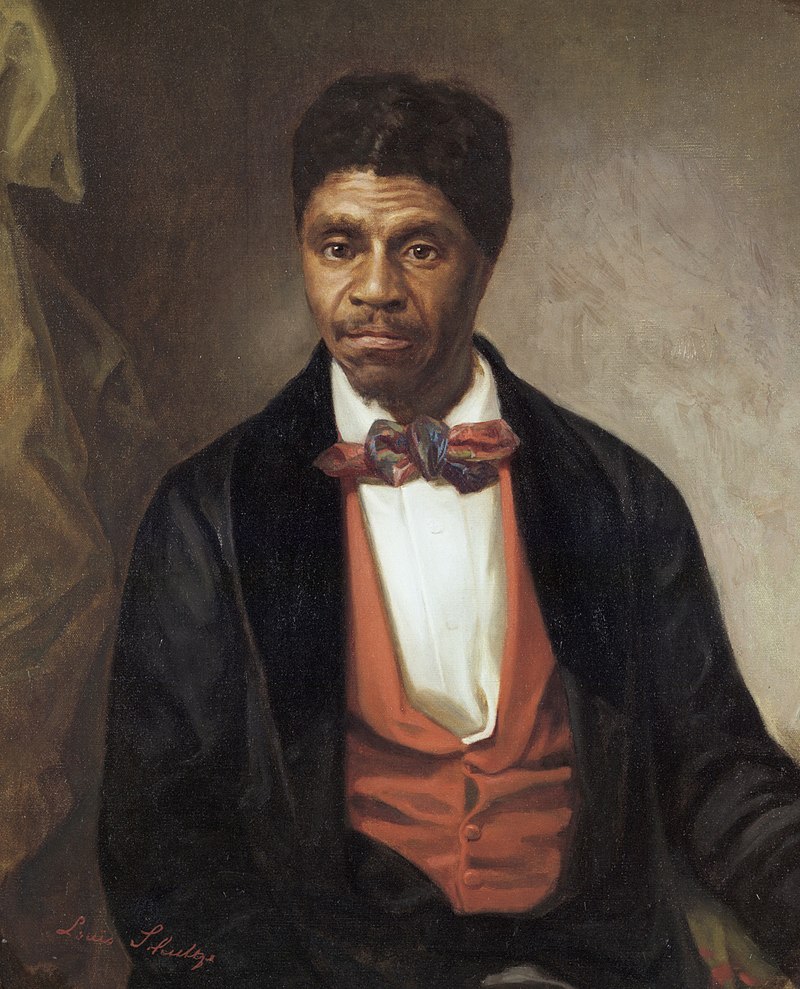
Dred Scott v. Sandford, 60 U.S. (19 How.) 393 (1857), was a landmark decision of the United States Supreme Court in which the Court held that the United States Constitution was not meant to include American citizenship for people of African descent, regardless of whether they were enslaved or free, and so the rights and privileges that the Constitution confers upon American citizens could not apply to them.
The Supreme Court’s decision has been widely denounced, both for how overtly racist the decision was and its crucial role in the near collapse of the United States of America four years later. Bernard Schwartz said that it “stands first in any list of the worst Supreme Court decisions—Chief Justice Hughes called it the Court’s greatest self-inflicted wound.” Junius P. Rodriguez said that it is “universally condemned as the U.S. Supreme Court’s worst decision”. Historian David Thomas Konig said that it was “unquestionably, our court’s worst decision ever.” [John Sandford’s surname was actually “Sanford”. A Supreme Court clerk of court misspelled his name in 1856 and the error was never corrected. Vishneski, John S. (1988). “What the Court Decided in Dred Scott v. Sandford”. American Journal of Legal History. 32 (4): 373–390. doi:10.2307/845743. JSTOR 845743.]
Judgment reversed and suit dismissed for lack of jurisdiction.
- Persons of African descent cannot be and were never intended to be citizens under the US Constitution. Plaintiff is without standing to file a suit.
- The Property Clause is applicable only to lands possessed at the time of the Constitution’s ratification (1787). As such, Congress cannot ban slavery in the territories. The Missouri Compromise is unconstitutional.
- The Due Process Clause of the Fifth Amendment prohibits the federal government from freeing slaves brought into federal territories.

With Dred Scott, Taney’s Supreme Court permitted the unhindered expansion of slavery into all the territories.
Thus, Dred Scott decision represented a culmination of what many at that time considered a push to expand slavery. Southerners, who had grown uncomfortable with the Kansas-Nebraska Act, argued that they had a constitutional right to bring slaves into the territories, regardless of any decision by a territorial legislature on the subject. The Dred Scott decision seemed to endorse that view. The expansion of slavery into the territories and resulting admission of new states would mean a loss of northern political power, as many of the new states would be admitted as slave states. Counting three fifths of the slave population for apportionment would add to the slaveholding states’ political representation in Congress.
Prognathous ~ (especially of a person) having a projecting lower jaw or chin; (of a jaw or chin) projecting; (of an insect) having projecting mouthparts.
Homework 5: Nat Turner and Abolitionism First, read the account on Nat Turner’s Revolt. In response to the slave rebellion, Southern states began to harden in their resistance to criticism of slavery, and blamed the growth of the abolition movement for the revolt. Abolitionist William Lloyd Garrison began publication of the Liberator, an antislavery newspaper, in Boston in 1831. The second document for you to read is a Garrison article on the Constitution. The third document, on the gag rule, refers to the refusal to let the U.S. House of Representatives consider abolition petitions. The fourth document concerns the permission granted to Southern postmasters to destroy abolitionist society mail. The last document is the illustration ‘Southern Ideas of Liberty.’
Reading notes:
On the Constitution and the Union (1832). By William Lloyd Garrison in THE LIBERATOR Vol. II. No. 52 (December 29, 1832) __ Fair Use Repository-1.pdfDownload
Reading notes:
Reading notes:
As veterans of the Bible and religious tract movements, the founders of the American Anti-Slavery Society (AASS) believed in the power of the printed word to convert sinners, including those whose sin was slaveholding. Immediately after its founding in 1833, the society began publishing a broad range of newspapers, tracts, circulars, and periodicals. Within two years, AASS was printing more than a million copies a year. In 1835 the society launched a dramatic effort, dubbed the Great Postal Campaign, to flood the South with antislavery tracts and periodicals. This has sometimes been called America’s first direct-mail campaign. In the South the result was not conversion but outrage and hysteria. Though federal postal law guaranteed the security of the mail, Postmaster General Amos Kendall (1789-1869), a close ally of President Andrew Jackson (1767-1845), gave permission to Southern postmasters to refuse delivery of abolitionist materials. Thus, the U.S. postal service, the great nationalizing institution of the American political experiment, became an instrument of states’ rights in the realm of slavery and abolition.
Attack On the Post Office, Charleston, S.C. · The News Media and the Making of America, 1730-1865.pdfDownload
Attack On the Post Office, Charleston, S.C. · The News Media and the Making of America, 1730-1865.pdfDownload
Reading notes:

How did white southerners defend the institution of slavery? After the American Revolution, many white southerners defended slavery as a “necessary evil.” The criticisms of abolitionists and Nat Turner’s slave rebellion forced slavery’s defenders to reconsider that argument. Thomas Dew, George Fitzhugh and others fashioned a pro-slavery argument in which they maintained that slavery was beneficial to slaves and masters, and was superior to the North’s system of free labor.
- Thomas R. Dew Defends Slavery (1852)
- Dew defends slavery against its critic
- George Fitzhugh: Slavery Justified (1854).
- Virginia attorney George Fitzhugh argues that slavery benefited masters and slaves, and produced a society more peaceful and productive than the free labor system found in northern states.
- George Fitzhugh: FROM The Blessings of Slavery (1857).
- Fitzhugh maintains that slavery is beneficial to African Americans because they do not possess the ability to care for themselves.
- John C. Calhoun on the Error of “All men are created equal” (1848)
- Calhoun attempts to reconcile the notion of a nation founded on liberty and equality with the reality of slavery.
- John C. Calhoun on the Error of “All men are created equal” (1848)
- Calhoun attempts to reconcile the notion of a nation founded on liberty and equality with the reality of slavery.
- James Henry Hammond, “The Mudsill Theory” (1858)
- Hammond claims that all societies, even the north with its system of free labor, depends upon on underclass of degraded workers.
- George Fitzhugh, “The Universal Law of Slavery” (1850)
- Fitzhugh offers a defense of slavery that is profoundly racist to modern readers.
On what grounds did abolitionists oppose slavery? Perhaps the most influential reform effort of the 19th century was abolitionism. It never attracted many followers; only two percent of northerners were abolitionists, and white southerners rejected the movement. Despite their small numbers, the abolitionists had a profound influence on the debate over slavery in the United States.
- William Lloyd Garrison: FROM First Issue of The Liberator (January 1, 1831).
- This excerpt reveals the depth of Garrison’s commitment to the abolitionist cause.
- Declaration of Sentiments of the American Anti-Slavery Society, William Lloyd Garrison (1833)
- This statement reveals the ways in which abolitionists framed debates over slavery as a moral issue.
- Lydia Maria Child, An Appeal in Favor of That Class of Americans Called Africans (1833)
- Abolitionist Lydia Maria Child dismissed the colonization of black Americans in Africa as a means to resolve the problem of slavery in the United States.
- Theodore Weld’s “Slavery As It Is” (1839)
- Abolitionist minister Theodore Weld argued that cruelty and abuse were essential features of slavery.
- William Goodell, “Liberty and Slavery” (1853)
- Abolitionists such as William Goodell compared the free labor system of the North with southern slavery.
- “Am I Not a Man and a Brother” Emblem (1787)
- Abolitionists adopted this emblem to illustrate a core concept of their cause.
- The Masthead from The Liberator
- The masthead of the leading abolitionist newspaper illustrated the misery of slavery.
- Illustration “Suffering in the South” (n.d.)
- This illustration offers an abolitionist’s perspective on the effects of slavery.
- Anti-Slavery Advertisement (n.d.)
- This image was intended to depict slavery as cruel and inhumane.
- Abolition, Fanaticism, and Freedom (1835)
- This New York newspaper article defends the free speech rights of abolitionists even as it condemns their cause.
- Anti-Abolition Broadside (1837)
- Southerners regarded abolitionism as a threat to their economic interests and to the nation’s future.
Class notes: March 2, 2022
Dred Scott – Chief Justice Roger Taney’s wrote in Dred Scott v. Sandford (1857) that the Founders’ Constitution regarded blacks as “so far inferior that they had no rights which the white man was bound to respect, and that the negro might justly and lawfully be reduced to slavery for his benefit.”
Sunday Selfie



Racist By Design
In America, the highways and public spaces that shape our cities were often intentionally built at the expense of minority citizens. When the “structural” racist, urban planner Robert Moses began building projects in New York during the 1920s, he bulldozed Black and Latino homes to make way for parks and built highways through the middle of minority neighborhoods.
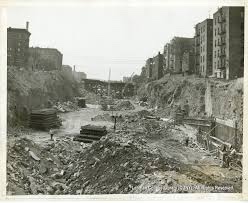
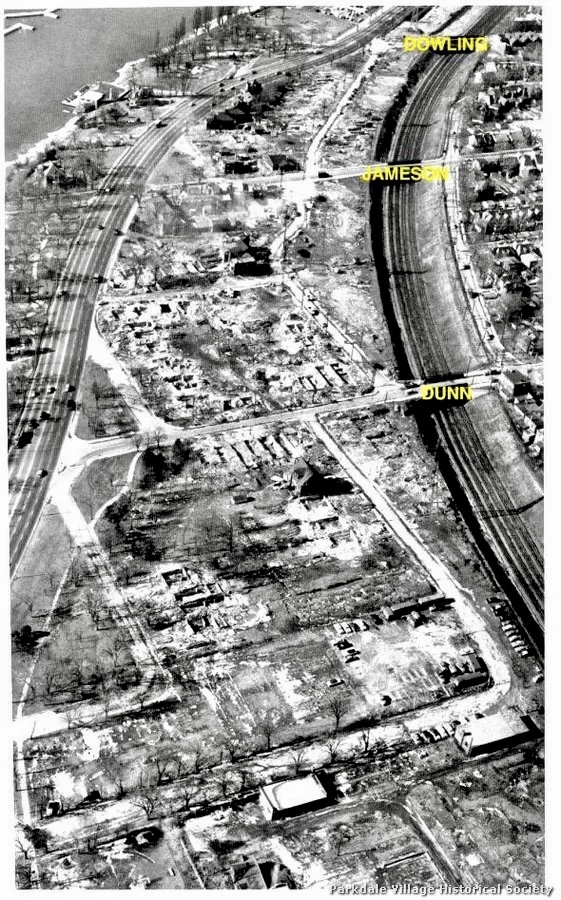
Completed in 1972, the 6.5-mile Cross Bronx Expressway bisects the borough east to west, carrying 300 diesel trucks every hour, on average. The resulting air and noise pollution contribute to a bevy of health problems, from asthma to COVID-19, for the 220,000 people who live near the highway, most of whom are Black and Brown.

An unapologetic racist and segregationist, Moses even ordered his engineers to build the bridges low over the Southern State Parkway connecting New York City to Jones Beach in Long Island. This kept city buses (which would likely be carrying poor Black & Brown people) from passing underneath. This and many more of Moses’ programs and designs influenced a generation of engineers, architects, and urban planners nationwide.
In Robert A. Caro’s 1974 biography of Robert Moses, “The Power Broker,” he describes Moses as, “the most racist human being I had ever encountered.” An example of the effect Moses’ projects have had on the residents of NYC: The Cross Bronx Expressway is just one major source of air pollution linked to high rates of asthma in nearby communities of color.
Read more:
https://fivethirtyeight.com/features/why-the-bronx-really-burned/
https://thebipartisanpost.com/all-articles/robert-moses-a-builder-of-prejudice
Day in the History of Racial Injustice
March 15, 2022 ~ Kevin Johnson was fatally shot 9 times in the back by three San Antonio cops. A crowd that gathered after the shooting clashed with police, who at one point used pepper spray on the group.
March 15, 1713 – Tuscarora Nation warriors withstood colonizers’ siege of Fort Neoheroka in North Carolina Territory for three weeks before most were burned to death in fire that destroyed the fort; survivors joined the Iroquois Nation.
Day in the History of Racial Injustice

March 13, 2020– Louisville, Kentucky, police fatally shot Breonna Taylor, a 26-year-old African-American woman, in her own home whole execution a no-knock warrant.
Day in the History of Racial Injustice
March 14, 2015 ~ This week, protesters marched after the Univesity of Oklahoma’s sigma Alpha Epsilon fraternity is taped singing a song that included the n-word and “You can hang him from a tree, but he’ll never sign me.”
Day in the History of Racial Injustice
March 12, 1956 – U.S. congressmen from 11 Southren states issued the Southern Manifesto declaring oppositition to Supreme Court’s Brown v. Board of Eduction decision, which prohibited racial segregation in public schools.
 Relentless Robin